Here’s another multi-author Bookfunnel promotion organized by Erica Ridley, this one featuring Enemies to Lovers romances. It runs from August 19 to September 5. The books aren’t necessarily discounted, and some may be in Kindle Unlimited. What they have in common is that trope.
Erica Ridley is coordinating a series of fun multi-author BookFunnel promotions, all featuring historical romances. This first one is a gorgeous collection of books with (yes) ladies in red on the covers.
The Lady in Red runs from August 12 to August 29. The books aren’t necessarily discounted, and some may be in Kindle Unlimited. What they have in common are beautiful red dresses! You’ll find The Christmas Conquest and The Crusader’s Vow on the landing page, as well as many other titles from your favorite authors.
Remember that the Champions of St. Euphemia series (including The Crusader’s Vow) will only be enrolled in Kindle Unlimited for another two weeks.
In my Blood Brothers series, Rafael and Maximilian have served as mercenaries in La Compagnie Rouge founded by their father, Jean le Beau. As warriors, they each have their areas of expertise—Maximilian (hero of The Wolf & the Witch) is a strategist, which makes him a natural leader. Rafael, his second-in-command, is an expert with Greek fire. Let’s talk about that medieval weapon today.
I decided that Rafael’s moniker would be The Dragon within the company, for his command of this weapon. He uses it in the assault upon Château de Vries in the prologue of The Wolf & the Witch, and again in the taking of that holding in The Dragon & the Damsel.
Greek fire originated in the east, and the oldest mention of it is by the Byzantines around 672. They used it mostly as a naval weapon and sprayed it as liquid from a syphon, which then burned, even on the surface of the water. Another name for it was “liquid fire”. Here’s an image from a 12th century chronicle depicting a 7th century Byzantine attack with Greek fire. It’s being sprayed on the enemy ship with a siphon.
Greek fire is depicted in medieval chronicles as an impressive tool. Knights from Europe first encounted Greek fire while on crusade. Here’s a vivid description from John de Joinville’s Chronicle of the Seventh Crusade: “the tail of fire that trailed behind it was as big as a great spear; and it made such a noise as it came, that it sounded like the thunder of heaven. It looked like a dragon flying through the air. Such a bright light did it cast, that one could see all over the camp as though it were day, by reason of the great mass of fire, and the brilliance of the light that it shed.”
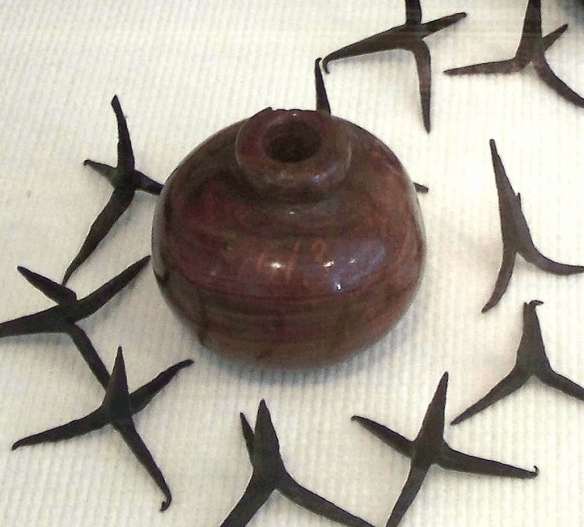
It could also be delivered in earthenware grenades, such as those used by Rafael. Here’s a picture of one of those ceramic grenades from the National Historical Museum in Athens. (Those are caltrops around it, an ancient Romance invention. They were scattered on roads to impede horses and foot soldiers. A caltrop always lands with one sharp point up.)
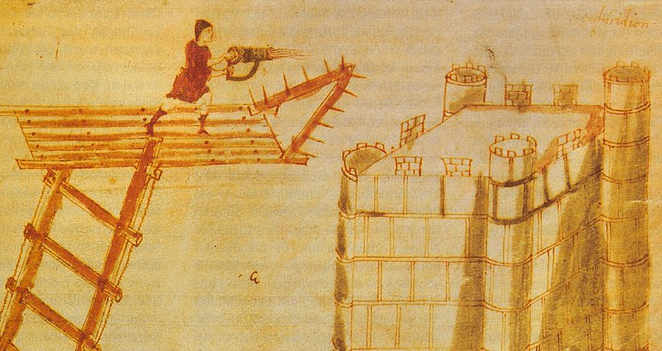
Greek fire could also be dispensed from a hand-held siphon called a chierosiphon, like the one in this illustration;
What was Greek fire? That’s a question people have been trying to answer ever since its use was first recorded! (It doesn’t help that crusaders used the name for all incendiary weapons.) It makes sense to look at Byzantine sources, since Greek fire originated there. Anna Komnene, a 12th century Byzantine princess, wrote a military history of Byzantium called the Alexiad, which includes this recipe: “This fire is made by the following arts: From the pine and certain such evergreen trees, inflammable resin is collected. This is rubbed with sulfur and put into tubes of reed, and is blown by men using it with violent and continuous breath. Then in this manner it meets the fire on the tip and catches light and falls like a fiery whirlwind on the faces of the enemies.“
Here’s another quote from Anna Komnene, about the design of siphons to make the delivery of the flame more fearsome: “As he [the Emperor Alexios I] knew that the Pisans were skilled in sea warfare and dreaded a battle with them, on the prow of each ship he had a head fixed of a lion or other land-animal, made in brass or iron with the mouth open and then gilded over, so that their mere aspect was terrifying. And the fire which was to be directed against the enemy through tubes he made to pass through the mouths of the beasts, so that it seemed as if the lions and the other similar monsters were vomiting the fire.”
Like many secret formulae, Greek fire was said to contain many components and the secret of its manufacture was closey protected: each person involved in the production knew only the details of his own contribution. As a result, even when the Byzantines lost siphons or even the liquid in battle, their enemies failed to use Greek fire themselves – they were missing at least one element for success.
By the fourteenth century, though, I think it possible that a man like Rafael might have collected knowledge of the entire recipe. His plan to protect his area of expertise is to never share the secrets with anyone. That comes naturally to a man who seldom trusts anyone. Will he be able to keep all of his secrets once Ceara begins to compromise his own defenses? We’ll see!
A mercenary convinced that each man must see to his own survival first, Rafael has learned to savor the moment and its pleasures. He is interested solely in conquest and coin, not any promise of the future—until an alluring maiden challenges him, defying him to stake a claim. Rafael cannot resist Ceara with her flame-red hair and keen wits, but their cat-and-mouse game takes a dangerous turn when Ceara is stolen by her kin. Rafael cannot stand aside when the damsel’s survival is at risk—though if she has stolen his shielded heart, she must never know of his weakness…
Ceara fled an arranged marriage, determined to wed for love or not at all. A horsewoman and huntress herself, she has encountered no man worthy of her affection—until she matches wits with Rafael, with his flashing eyes and seductive touch. She knows the handsome warrior seeks only one prize from her, but hopes to steal his heart. When she is captured and compelled to return to her betrothed, she is thrilled that Rafael lends chase. When he claims her as his own bride, Ceara dares to hope for more than a marriage of convenience.
But Rafael appears to be interested solely in conquest and passion, and their match becomes a battle of wills. Will Ceara be cast aside when her newfound spouse is offered the prize he desires above all else? Warrior and damsel, can these two wounded souls learn to surrender the truth of their hearts—before their union is shattered forever?
Glynnis Campbell has organized a multi-author BookFunnel promotion featuring medieval romances with knights. Hot August Knights features books at all price points and the links will direct you to the sales portals.
You’ll find The Wolf & the Witch featured on the landing page as well as my bundle, All’s Fair in Love & War, both at their regular prices. You’ll also find my First Knights bundle, which includes four medieval romance series starters, discounted from $9.99US to $2.99 for this promotion.
Yesterday, there was a post on the blog of my Deborah Cooke website, about my month in the garden this past May and the decisions I made while weeding. The upshot of it all is that I’ll be focussed on historical romance for the next year, to the exclusion of other sub-genres. I’m curious to see where this takes both my stress level and my sales.
So, here’s my publication schedule as it looks right now:
The Brides of North Barrows August 2022
The Dragon & the Damsel September 2022
The Masquerade of the Marchioness November 2022
The Widow’s Wager February 2023
The Scot & the Sorceress April 2023
One Knight’s Desire July 2023
I know more and have my work planned through the end of 2024, but I’d rather share details once I have covers and pre-orders. There will be more stories in The Ladies’ Essential Guide to the Art of Seduction published next year, for example. That series is planned to have seven books and will finish up in early 2024.
You probably noticed that One Knight’s Desire is back on the schedule for publication next July. I’ll be continuing with the Rogues & Angels series, which also is planned to be seven books long.
I’ve also decided to take my backlist titles out of Kindle Unlimited (not Blood Brothers just yet) and republish them at the other portals. That will probably take until the end of September, but if you’re reading in KU, finish up your series now.
This is a pretty relaxed schedule for me in terms of writing, so I have a number of other histrom projects that I’m hoping to tuck into the plan. I’ll write those first, then list them for short pre-orders when they’re done.











 Claire Delacroix