Tattoos

The Scot and the Sorceress, book four of the Blood Brothers trilogy by Claire Delacroix

In The Scot & the Sorceress, Nyssa has blue marks on her skin. What are they? They sound like they might be tattoos, but I never call them that.

The word “tattoo” is much more recent than the Middle Ages. There are several different attributions, but let’s go with the most popular: that it comes from the Samoan word ‘tatau’, meaning ‘to strike’—because a tool was struck against the skin to make the holes that would subsequently be filled with color. The word is not noted in English until the 18th century, introduced after Captain Cook’s travels to the south Pacific—where he noted the beautiful art adorning people’s bodies in Tahiti. His account of his voyage is the first use of the word in an English source.

The art of marking the skin, though, goes back much further than this. The oldest figurative tattoos were found in 2018 on the bodies of two mummies from Ancient Egypt, dated between 3351 and 3017 BCE. I couldn’t find any pictures of them, but there are many images online of Otzi, a mummified corpse discovered in the Alps with over 60 tattoos, dated to 3250 BCE. Here’s an article at the Smithsonian showing Otzi’s tattoos and telling more about him.

My favorite ancient tattoos are those of the Princess of Ukok, a woman discovered in Siberia and sometimes called the Siberian Ice Maiden. She was buried in the 5th century BC and discovered in 1993 – she was of the Pazyryk tribe, who lives on the Eurasian Steppe, and was buried in what is now the autonomous Republic of Altai. She was between 20 and 30 years of age, and was buried with six horses, an elaborate headdress, ornaments and offerings, indications that she was a priestess and/or shaman. She had gorgeous tattoos. You can read the Wiki about her here.

Line drawing of the tattoo on the left shoulder of the Princess of Ukok

A second tomb was found in the same vicinity for a man who also had beautiful tattoos. This article is about both of them but the first illustration shows the man’s tattoos. Scroll down to see her tattoos. The most remarkable one, for me, is the creature on her left shoulder. Here’s a drawing of it from Wiki.

There are many other peoples who have marked their skin in the past five thousand years, but we’ll look finally at the Picts, who resided in the area Fortrui—now Inverness and Moray—before the 8th century. We don’t know what they called themselves, but the Romans called them Picti from the 3rd century, which means ‘painted ones’. Some interpret this as meaning that the Picts tattooed themselves; others suggested that they painted their bodies. Blue is a common color associated with this ornamentation.

For the imagery of Nyssa’s tattoos, I took inspiration from the many carved stones created by the Picts. Although these peoples left no written records, they did leave a number of these stones, and there are common elements in their imagery. (The Aberlemno I stone is a good example.) These include serpents, the double disk and Z-rod (you can see one of these on a silver plaque in the Norrie’s Law Hoard), the mirror and comb, the so-called Pictish Beast, and insular interlace similar to what we see in other Celtic images and depictions of animals. The St. Ninian’s Isle treasure is considered the best collection of Pictish items and includes many ornamental penannular silver broaches. I chose a serpent for one of her tattoos, although there are many many possibilities here.

How did ancient people make tattoos? Presumably, they also pierced the skin then rubbed pigment into the holes. What did they use for color? It’s possible that they used woad, a blue dye derived from the plant Isatis tinctoria which was a popular dye for cloth in the Middle Ages. (Although indigo has been known as a blue dye for millennia, it was rare in Europe in the Middle Ages, as it had to be imported from much warmer climates.)

Nyssa’s tattoos are a fictional invention of my own, but they’re not that implausible. It only makes sense to me that such marks would be indicative of achievements for a seer or shaman, but that too, is part of my fictional world of The Scot & the Sorceress.
Witching Stones

The Scot and the Sorceress, book four of the Blood Brothers trilogy by Claire Delacroix

In The Scot & the Sorceress, Nyssa uses a witching stone to see into the future. This is a stone with a hole in the middle, and can also be called an adder stone, a hag stone, or a serpent’s egg. These stones occur naturally and are probably the result of water eroding the stone, but they’ve been considered special (if not magical) for a long time.

Pliny, in his Natural History, made note of the popularity of such stones amongst the Druids. This is probably the oldest written reference to a witching stone. Here’s a quote:

“There is a sort of egg in great repute among the Gauls, of which the Greek writers have made no mention. A vast number of serpents are twisted together in summer, and coiled up in an artificial knot by their saliva and slime; and this is called “the serpent’s egg”. The druids say that it is tossed in the air with hissings and must be caught in a cloak before it touches the earth. The person who thus intercepts it, flies on horseback; for the serpents will pursue him until prevented by intervening water. This egg, though bound in gold will swim against the stream. And the magi are cunning to conceal their frauds, they give out that this egg must be obtained at a certain age of the moon. I have seen that egg as large and as round as a common sized apple, in a chequered cartilaginous cover, and worn by the Druids. It is wonderfully extolled for gaining lawsuits, and access to kings. It is a badge which is worn with such ostentation, that I knew a Roman knight, a Vocontian, who was slain by the stupid emperor Claudius, merely because he wore it in his breast when a lawsuit was pending.”

Such stones are mentioned twice in the Mabinogion collection of Welsh prose tales: a magical stone is given to Peredur, which allows him to see and kill a fearsome but invisible beast called the Addanc, and Owain is given a stone by a maiden which allows him to become invisible and escape captivity.

In folklore, hagstones are believed to be protective – good things can pass through the hole to you, but bad things can’t. You can wear a hagstone on a cord for good luck, hang one from your bedpost to keep bad dreams away, hang it over a door or window to keep evil spirits away, or have one on your ship to keep storms away. They are used to cast spells by some witches, and evidently can break spells, too.

Of course, they also offer a view into other dimensions when you peer through the hole, like the realm of the Fae or the dead, which is how Nyssa uses her stone in The Scot & the Sorceress.

Fourteenth Century Armor

Today’s research post is about 14th century armor. In 1300, armor was mostly chain mail: by 1400, it had evolved to be mostly plate armor. How and when various warriors changed the style of their armor would depend upon where they lived and how affluent they were. My Blood Brothers series is set in 1375 so the armor worn by the knights and mercenaries in the story will be mixed.

We can look at the tomb of the Black Prince, which was made ca. 1386 for an idea of what was typical in that era. Edward the Woodstock, or the Black Prince, was the heir to the throne as son of Edward III – he died slightly before his father, though, in 1375 and was never king. (Edward III died in 1376.) An effigy of the Black Prince was cast of him arrayed for war – which had been his own request – and it remains at Canterbury cathedral, along with his gauntlets, shield and jupon. He was considered to be an admirable knight and a flower of chivalry. Although the effigy was created about ten years after his death, it is a precise replica of his armor – to the point that recently, it’s been concluded that an armorer was part of the team who created the effigy. (Here’s an article at the Smithsonian’s site about that.)

Most of the images I found online were copyrighted, so I’ll point you to this article at Atlas Obscura which has some good pictures. Hurry back. 🙂

You can see that Edward is wearing a mail collar (called an aventail) to protect his neck and shoulders, and there’s a glimpse of his mail hauberk beneath his surcoat from the side view. There would be a padded aketon beneath it. He wears a basinet of plate armor – his helm would go over this – and his gloves are reinforced with plate metal that covers the hands and wrists. These are called hour-glass latten gauntlets. Then there are more metal pieces to protect the fingers. (In the actual gloves, you can see the leather base where it survives.) His surcoat is embroidered with his insignia, quartered with the fleur-de-lis of the French crown and the three lions rampant of the Plantagenets. He wears plate armor greaves on his legs, sabatons on his feet and defences on his arms – and he has a moustache. 🙂 So, his armor is mostly plate, worn over the chain mail hauberk and with the addition of a mail aventail. The surcoat, which in the previous century fell to the knees and was called a tabard, is also shorter, falling just to the hip, and more fitted.

There is a British artist named Graham Turner who has doen many illustrations for books about armor. That link takes you to the website for his gallery, but you can also search for images by his name. There are many which show all of the elements of clothing and armor for a specific era.

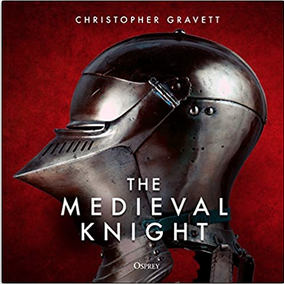
The Medieval Knight by Christopher Gavett

Here’s one of a Knight and equipment c. 1350 (this site licenses images to users but I’ll just point you to it). It’s included in a wonderful little book called The Medieval Knight by Christopher Gravett. (That’s an Amazon link.) The book has a lot of illustrations done by Graham Turner and they’re wonderful. You can see the developments in 40 years by comparing that image to this one, Knight and equipment c. 1390 – actually, the original prints of both of these images were available at the gallery and are still displayed on that site, along with Knight and equipment c. 1310. That page is right here. Click on the image to see it larger.

This knight (1390) wears a padded jupon over his armor with his insignia on it. You can see all the little ties and buckles which necessitated the services of a squire to fasten all around the back. The aketon and mail hauberk would still be worn underneath. The leg armor is now four pieces: the cuisse on the thigh, the poleyn over the knee, the greave on the shin and the sabaton on the foot. The belt with the scabbard for the sword and dagger is also worn much lower, around the hips. Around this time, armor starts to be modified for jousting, but we’ll talk about those developments next time.

My thinking that in the Silver Wolf’s company, only Amaury would have anything close to this full 1390 kit. He would keep it after leaving Château de Vries – of course! – but wouldn’t wear it all of the time. He’s trying to blend in with the company of mercenaries—at least until he escorts Elizabeth to her wedding and insists that they must “arrive in splendor” as a show of strength. As you might guess, Elizabeth will be a little dazzled by the man she’s previously seen as a huntsman when he appears in his full glory.

Next time, we’ll talk about Amaury’s (former) passion – jousting and tournaments.


The Hunter & the Heiress, book two of the Blood Brothers series of medieval Scottish romances by Claire Delacroix

Nothing could be further from Amaury de Vries’ expectations than being compelled to join a company of mercenaries in the wilds of Scotland, much less one led by his notorious half-brother. He chafes to return to his former life of privilege and knows a wealthy bride will allow him to regain his stolen legacy. Elizabeth is a prize unexpected—beautiful and an heiress—and when she is abducted by barbarians, Amaury’s path is clear. He may not be the sole contender for the lady’s hand, but he knows himself to be the best one—and he will use whatever means necessary to seal his triumphant claim.

All Elizabeth D’Acron desires is to wed for love, but her inheritance has made her both a pawn and a prize. Caught between warring chieftains, her defiance blossoms—she chooses instead to flee with Amaury and make a marriage of convenience, hoping her trust in the gallant knight is not misplaced. She does not expect the beguiling fire awakened by Amaury’s touch, much less his unexpected conquest of her heart, and she dares to hope that true love has found a way.

But Elizabeth’s legacy is not so readily claimed—when Amaury’s plan is revealed, she is shattered to learn that her chivalrous husband is no different from other men. Recognizing that the true prize is his lady wife, Amaury rejoins the company of mercenaries and leads the battl to ensure Elizabeth’s freedom, whatever the cost to himself. Can these two lovers overcome the wounds of the past to build a future together? Or will the secret behind Elizabeth’s inheritance destroy any such hope forever?

Coming in January 2022!


The Hunter & the Heiress will ba availble in wide distribution for one week after publication, then it will be exclusive to Amazon and enrolled in Kindle Unlimited.


Pre-order available at some portals:


The Hunter & the Heiress, book two of the Blood Brothers series of medieval romances by Claire Delacroix, audio edition

The Hunter & the Heiress will also be available in an audio edition, narrated by Tim Campbell.