The Blood Brothers series of medieval romances is being narrated by Tim Campbell. The audiobooks will be released as close to the publication date of the ebooks as possible. The Wolf & the Witch is available in audio now!
The Wolf & the Witch
Five Stars! Highly recommended as an excellent series starter of a place to start your love affair with Claire Delacroix books in general!”
Becca – Goodreads reviewer
Five Stars! Delacroix is a masterful storyteller who weaves together a fascinating tale of betrayal, vengeance, wit, fate and love!
In The Wolf & the Witch, Maximilian gives Alys “poppy powder” which makes her sleep. This is the powder derived from poppies, specifically from opium poppies native to Asia Minor. The Latin name for the opium poppy is Papaver Somniferum, or sleeping poppy. The medicinal powers of the opium poppy have been known since at least 3000 BC.
The Sumerians called it the “joy” plant, and described how to harvest “poppy tears”, a method that is still used today. To harvest the opium, the seed pod is left to ripen after the plant blooms. After about 10 days, the pod is cut so that the milk oozes from it. That sap is left to dry, then the residue is collected and dried even more. The seed pod is distinctively round.
The ancient Greeks used poppy powder as a sedative, and also combined it with poison hemlock for suicide or euthanasia. It may have had ritual use in Egyptian society as a drug of healing power. The Greek gods Nix, Thanatos and Hypnos were depicted with poppies in Greek art. It was known to be a powerful and effective sedative and traded widely, as we can see by its inclusion in pharmacopiae and herbals from China to Europe. Around 2000 years ago, it was included in the Chinese pharmacopia, the Pen Tsao. It is included in the references to healing and medicine by Galen of Pergamon (a Greek physician who died c. 210 AD) and Pedanius Dioscorides (a Greek physician c. 40 – c. 90 AD.). This is an excerpt from Galen’s Alphabet, translated by Nicholas Everett, following a description of the harvesting process.
“The best opium has an extremely pungent fragrance, is slightly reddish in colour, very quickly dissolves and turns white when in contact with moisture, and when ignited emits a flame that burns for a little while and which when extinguished replenishes its fragrance to the same level of pungency as when fresh…Pure opium can be mixed into eye-salves for drying up teary eyes, or can be smeared on around areas that need cooling. It alleviates earaches, reduces all types of fatigue in the body, and for the same reason we find it also induces sleep.”
Pharmacy from Antiquity to the Middle Ages:The Alphabet of Galen, Nicholas Everett, University of Toronto Press, 2012, 2014, page 297
Even though the alkaloids are derived from the sap of the seed pod, there are no active alkaloids in the seeds once they develop.
The powers of the opium poppy were also referenced by the Persian physicians “Rhazes” (845-930 AD) and “Avicenna” (980 – 1037 AD), and the Andalusian surgeon “Abulcasis” (936–1013 AD). Galen shows that it was known in the Roman Empire, but the author of The Old English Herbarium, an Anglo-Saxon herbal from about 1000 AD, appears to be unfamiliar with the differences between the white poppy that grows in England and the opium poppy – although these two plants share some traits, there is virtually no opium in the English poppy, papaver album.
We can take a little tangent here and talk about the transmission of ancient texts like pharmacopiae and herbals. The Roman Empire was divided into the eastern and the western empire by Constantine (Roman emperor 306 – 337), who named the capital of the eastern empire after himself, Constantinople, later Istanbul, was a large and busy city and a trade hub for centuries. The eastern (or Byzantine) empire also held Ravenna, a city in northern Italy. In 390, Rome was sacks by Goths, and in subsequent centuries, the raids by Vandals, Visigoths, Vikings and others saw many literary sources destroyed in Europe and libraries burned. There were copies of all those books in Constantinople, where they were translated into Arabic by Muslim scholars and studied. When the Umayyad caliphate conquered much of what is now northern Africa and the south of Spain CA. 700 AD, those books made their way to Andalusia. Under the Umayyads, Christians, Jews and Zoroastrians (known as dhimmis) were permitted to practice their religion but paid a higher tax. In this culture, those texts were translated from Islam to Latin, often by Jewish scholars, and made their way back into Europe from Spain to be rediscovered. In addition, eastern sources previously unknown in Europe were translated and transmitted. Avicenna’s Canon of Medicine was translated from Arabic into Latin in 1175, for example, and his work became known in Europe after that. This contributed to what medieval scholars call the Twelve Century Renaissance, a period of increased literacy and learning in Europe.
It also coincides with the crusades. Crusaders brought opium back to Europe from the 11th to 13th centuries and it became an imported (and important, because of its efficacy) ingredient for European herbalists who could afford to acquire it. The first stories of opium addiction date from the 14th century, although it was known to be an addictive substance before that.
The active ingredients in herbs and plants vary in their power, based on the plant’s growing conditions, the weather and the means of harvest and refinement. Dosage can be a bit of a guess, and relies heavily upon the herbalist’s experience and knowledge of the plant’s source. Morphine was the first plant alkaloid ever isolated, from opium in 1803, which meant that dosages could be measured with precision for the first time. Heroin, which is synthesized from morphine (and was called diamorphine), wasn’t developed until 1893. In 1895, it was marketed as a cough suppressant. Both of these developments meant that opium-derived alkaloids and synthesized versions of them became much more readily available and that addiction became more prevalent.
Opium poppies can be grown as an ornamental garden plant. They’re perennials in many climate zones and have spectacular flowers. (Other varieties of poppies are self-seeding annuals and have very little alkaloid in them.) Here’s a lovely pink cultivar at right.
Even the varieties of papaver somniferum available at your local garden center may have been bred to be devoid of latex and alkaloids. These are sometimes called Breadseed Poppies, when the intention is that you harvest the seeds for your bagels. In some places, it is illegal to cultivate them so check before you plant.
As for Maximilian’s use of poppy powder, it makes sense to me that the leader of a free company of mercenaries – who regularly engaged in battle and were therefore injured – would be well aware of a sedative and painkiller, and familiar with its use. He also would have had the opportunity to acquire it on his travels – in major cities – and the funds to acquire it. Alys, having been taught by a healer, might well have been taught about it but never have seen any of it herself – until Maximilian’s arrival. It would have been far less refined and less potent, but they still refer to Eudaline’s expertise in its administration.
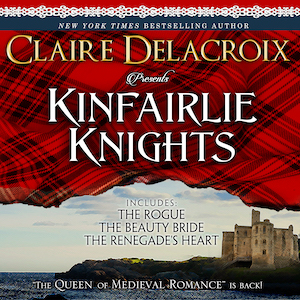
I’ve published my first audiobook bundle: Kinfairlie Knights is now available!
Welcome to Kinfairlie and Ravensmuir! Claire Delacroix’s fictional medieval Scottish estate of Kinfairlie and its sister holding of Ravensmuir are the location for many of her bestselling medieval romances. Included in this digital bundle are three first-in-series medieval Scottish romances: The Rogue, The Beauty Bride, and The Renegade’s Heart.
In The Rogue—book #1 of the Rogues of Ravensmuir trilogy—Ysabella’s estranged husband returns to beg for her help. Does she dare to trust Merlyn again, knowing that he stirs her passion as easily as he hides his truth?
In The Beauty Bride—book #1 of the Jewels of Kinfairlie series—Madelyn flees her arranged marriage to a notorious outlaw, only to be pursued, wooed and seduced by Rhys FitzHenry. Can she save him from the legacy of his own past?
In The Renegade’s Heart—book #1 of the True Love Brides series—Isabella is intrigued by the bold knight who makes accusations against her own brother. When she follows Murdoch to discover the truth, she finds herself enraptured by his touch and determined to defend his cause. Can her love save Murdoch from his curse and see justice served, too?
Come to Kinfairlie, for adventure and romance, passion and pageantry, and loves that will endure for all time.
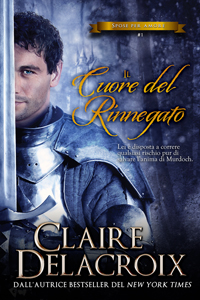
My medieval romance, The Renegade’s Heart, is now available in an Italian edition!
Lei è disposta a correre qualsiasi rischio pur di salvare l’anima di Murdoch.
Liberato dalla prigionia delle Fate, Murdoch Seton non vuole altro che dimenticare gli anni che ha perduto. Per questo, intraprende una missione per recuperare il tesoro rubato alla sua famiglia…senza tuttavia fare i conti con una strana fanciulla, l’unica che può aiutarlo a scoprire il mistero del furto e a redimere se stesso.
Isabella si indigna davanti al rinnegato che sta occupando il mastio del fratello, soprattutto quando si tratta di un cavaliere troppo bello per il suo bene…e per il proprio.
Ma è sufficiente un unico incontro, per convincerla che la causa che lo ha portato lì è giusta e per spingerla a rivelargli il nome del ladro, senza minimamente immaginare che il bacio che si sono scambiato ha scatenato una vera e propria battaglia nell’anima di Murdoch.
Quando le Fate tornano a reclamare Murdoch per sempre, Isabella cerca di aiutare il cavaliere che le ha rubato il cuore.
Ma lui le permetterà di correre un tale rischio? Oppure si sacrificherà per salvarla?
I have a new boxed set coming in August of four medieval romance series starters. This is a great way to sample my various series of books.
First Knights includes four medieval romance series starters from the Queen of Medieval Romance, Claire Delacroix. Be swept away to a realm of pageantry and chivalry, where each knight competes for his lady’s favor, each lady knows her heart’s desire—and love conquers all. Included in this digital bundle are four first-in-series medieval romances: One Knight Enchanted, The Princess, The Beauty Bride and The Crusader’s Bride.
In One Knight Enchanted—book #1 of the Rogues & Angels series—Annelise seeks refuge at a keep when she is separated from her party and pursued by hungry wolves. The price of admission is marriage to its mysterious lord, and she agrees—only to find herself in a luxurious palace, and seduced by her secretive spouse. Her new husband believes he is doomed, but Annelise knows that love can conquer all. Can she save her husband from the curse placed upon him, or will breaking her promise to him cost any chance to win his wary heart?
In The Princess—book #1 of the Bride Quest series—Brianna is obliged to choose one of three brothers as her husband. Instead, she challenges them, vowing to wed the one who brings her a gift that makes her laugh. She has no intention of laughing at all, but one brother, Luc, declines to follow her whim. Sparks fly between the willful princess and the disillusioned knight after his brothers depart, and from this battle of wills, an unexpected love dawns. When the other knights return, will Luc take up his sword again to defend the maiden who has claimed his heart, or will Brianna be compelled to wed another?
In The Beauty Bride—book #1 of the Jewels of Kinfairlie series—Madeline flees her arranged marriage to the notorious outlaw Rhys FitzHenry, only to be pursued and seduced by her stubborn betrothed. Is she just a possession to this man who wants a son above all else, or can she capture his love for her own? Why does Rhys tell her so many stories, and what do they reveal about her enigmatic husband’s hidden heart?
In The Crusader’s Bride—book #1 of the Champions of St. Euphemia series—the widow Ysmaine makes a marriage of convenience, accepting the offer of a Templar knight in Jerusalem who is leaving the order to return to France. When their party is attacked, Ysmaine learns that Gaston carries a secret treasure in trust for the Templars, Ysmaine knows that her new husband’s survival may depend upon her assistance—and that this man of honor has stolen her heart. Can she persuade him of the merit of love and trust before it’s too late?
The First Knights digital boxed set includes four thrilling series starters by Claire Delacroix, bursting with medieval romance, adventure, suspense, and love everlasting. Be swept away to Claire’s medieval world in this introduction to four of her medieval romance series today!
Coming August 17 Pre-order available at some portals:




 Claire Delacroix