Horwood’s Plan – a Map of Regency London

The Widow's Wager, book 3 of The Ladies' Essential Guide to the Art of Seduction series of Regency romances by Claire Delacroix

Many of you know how much I love maps, and while writing The Widow’s Wager, I began to chart the locations of all my fictional houses in my two Regency romance series.

Horwood’s Plan is a map of London from the Regency era. The full name of it is: Richard Horwood’s PLAN of the Cities of LONDON and WESTMINSTER the Borough of SOUTHWARK, and PARTS adjoining Shewing every HOUSE (1792-99).

It really does show individual buildings, which is pretty cool.

You can also access the map online. This is an interactive map, so you can scale it and scroll it to focus on whatever detail you wish to see. I can lose days with this tool!

You’ll find it right here.

The other fabulous thing about this map is that there are overlays available. You can, for example, choose the overlay for Harris’s List to Covent Garden Ladies, right here, to see the locations of the various ladies’ residences. Hovering over a pin will bring up the listing for that lady from the guide published in 1788.

There are more overlays as well, if you’re in the mood to explore.

Harris’s List of Covent Garden Ladies

The Widow's Wager, book 3 of The Ladies' Essential Guide to the Art of Seduction series of Regency romances by Claire Delacroix

In The Widow’s Wager, Miss Esmeralda Ballantyne introduces Eurydice and Catherine to a scandalous little volume and guide to the Cyprians of Regency London called Harris’s List of Covent Garden Ladies.

Harris’s List of Covent Garden Ladies was a real publication, printed in London from 1757 through 1795, being updated most years. It was a guide to prostitutes and courtesans, complete with their names—perhaps with one letter missing—and addresses, as well as notes upon appearance, specialities and prices. The excerpts that Catherine and Eurydice read in the prologue are from editions of the guide.


The volume was originally compiled by Samuel Derrick, a linen draper from Dublin who came to London to pursue his dream of becoming an actor, dramatist and famed poet. In London, Derrick frequented The Shakespear’s Head, a coffeehouse in Covent Garden, whose chief waiter, one John Harrison, called himself the Pimp-General of All England. Inspired by this procurer’s own notes on the local ladies, Derrick created and published his own volume when in desperate need of money. There was likely an agreement with Jack Harris for the use of his name—although he subsequently published a competing title, which was not a success — although Derrick used his own observations. Derrick’s contribution remained anonymous for decades. It was a very popular little volume and it was believed to have sold 8000 copies per year in the 1760s. After Derrick’s death in 1769, the book continued to be updated by others, until its publication was ceased in 1795.


Hallie Rubenhold has written about this book—Harris’s List of Covent Garden Ladies: Sex in the City in Georgian Britain—as well as 18th century courtesans like Charlotte Hayes in The Covent Garden Ladies.

About Regency Marriages

The Masquerade of the Marchioness, a Regency romance by Claire Delacroix

Yesterday, in response to a question from a reader on my ARC team, I added an author’s note to The Masquerade of the Marchioness. If you pre-ordered the book, you’ll probably get the version without the Author’s Note, so you can read it in this blog post.

The question was about the legality of Garrett marrying Penelope, the sister of his dead wife. This is against ecclesiastical law and always has been – marrying the sibling of a dead spouse, or the spouse of a dead sibling (remember Henry VIII) was considered to be consanguinity, even though technically, the couple were not blood relations themselves. It is, however, a tidy solution, when women were more likely to die in childbirth – marrying the dead wife’s sister would provide care for the existing children and some familiarity. The sister couldn’t live respectably in the house of a widower (even her dead sister’s husband) but it was likely that the children already knew her.

There were two hurdles to doing this, however: first, the would-be groom had to find a minister to perform the religious ceremony. Second, the marriage could be challenged by any “interested party” so long as both wife and husband were alive, in which case, it could be annulled or voided. Annulling the match would make their children illegitimate, which could deprive those children from inheriting.

Let’s create an example from Jane Austen’s own work. At one point, Elizabeth says to Jane: “I am determined that only the deepest love will induce me into matrimony. So, I shall end an old maid, and teach your ten children to embroider cushions and play their instruments very ill.” Let’s imagine that Elizabeth and Mr. Darcy never worked out their differences, and this scenario happened instead.

Now, some math. 🙂 If Jane married at 22 – she might have been 23 by the time of the actual marriage, but let’s go with 22 and skew younger – it would take her probably 15 years to have 10 children. It might take closer to 20, but again, we’ll skew younger. So, if she died in childbirth delivering that 10th child, she’d be at least 37. Elizabeth, if unwed, might have come to live with her and Bingley at some point during those 15 years – likely when their father died and Longbourn passed to Mr. Collins. (“Turned out in the hedgerows” as anticipated by Mrs. Bennet, any surviving sisters who were not yet married might also have joined the Bingley household. Alternatively, they and Mrs. Bennett could move in with Mrs. Bennet’s remaining family, either Mrs. Phillips in Meritton or Mr. Gardiner in Gracechurch Street in London. But Elizabeth, certainly, would have gone to Jane and been welcomed.) So, if Jane passed when she was 37, Elizabeth would have been two years younger, 35, and quite unlikely to marry at that point. Mr. Bingley might have married her to provide a maternal influence (and an organizational force) in his household. This purely practical arrangement might have suited both of them well. It might not even have been a consummated match in the end, but it’s a very plausible solution to the dilemma of those ten children being motherless and Bingley, having lost the love of his life, being disinclined to seek another bride who would never hold his heart. He might, quite reasonably, invest his emotional energy in his children by Jane. He might also want to ensure Elizabeth’s financial security as he would be fond of her—if he didn’t make this choice, she would have been looking for somewhere to live, possibly with one of the Gardiner’s children, her nieces and nephews. Remember that Elizabeth’s income after her parents’ death was estimated to be £50 a year, which isn’t much.

There are three well-known examples from the Regency era of men doing this (see my Author’s Note), but there must have been more. The 1835 Marriage Act validates any existing such marriages but forbids them in future. But why was there a marriage act at all?

In one of my first medieval history courses at university, one of our assigned books to read was a law code. (It was the Lex Burgundionum from about 500 AD – that’s a Wiki link) Oh, how dull! I think everyone groaned simultaneously in the lecture hall – until the prof pointed out that law codes aren’t so much about what people should do. They are often a response to what people are already doing. So, why did British parliament debate the question of a man marrying his dead wife’s sister? I suggest that it’s because many men were doing it, and those who believed it to be wrong wanted to see the practice stopped. Parlaiment wouldn’t have reviewed and debated a law to address three instances.

The fact remains that Garrett and Penelope could have married. Who could have challenged the match as an interested party? Although this reader suggested that Penelope’s family might do as much, maybe to make trouble, I think this unlikely. If the match was annulled, they would lose all association with the marquis and his father the duke, and thus sacrifice any perks resulting from that connection. The most likely person to challenge the match for personal gain would be Christopher or Anthony, Garrett’s younger brothers, who might wish to take the place of Garrett’s sons in the line of inheritance of the duchy. But Garrett’s sons (his heir and spare) are by Philomena, so their inheritance would be unaffected by the dissolution of his marriage to Penelope. It seems unlikely to me that Christopher or Caroline, given their affection for Garrett and Penelope, would even think of doing this.

So, I don’t see this detail as a challenge to Garrett and Penelope’s HEA, but it is interesting to explore. (You know me – any excuse to dig into the research books!) Thanks to Rebecca for raising the question in the first place. 🙂

Here’s the new Author’s Note at the end of the book:

Author’s Note for The Masquerade of the Marchioness

Could a man marry his dead wife’s sister in the Regency? Technically, he could, although the marriage could be challenged as being within the prohibited degrees i.e. because the couple were too closely related, according to ecclesiastical law. If the marriage was challenged by an interested party, it could be voided or annulled, so long as either husband or wife were still living. This could cast the inheritance of any children into question.

All the same, men did marry the sisters of their dead wives without those matches being challenged. Examples include Richard Lovell Edgeworth, Matthew Boulton and Rear Admiral Charles Austen. Charles was Jane Austen’s brother: he married Frances Palmer in 1807 and Frances’ sister Harriet in 1820 after Frances had died.

Given the nature of Penelope’s blood family, I think it unlikely that they would challenge Penelope’s marriage to Garrett, as that would end their relationship with both the marquis and the duke, and any benefits resulting from that association. Theoretically, Christopher or Anthony could challenge the match in the hope of securing more favor for their own children, but Garrett has an heir and a spare by his first marriage whose claims are beyond dispute. I think we can be confident in Penelope and Garrett’s HEA.

The 1835 Marriage Act made all such existing marriages legal and any subsequent marriages of this type void. It ultimately became legal for a man to marry his dead wife’s sister in 1907, and for a woman to marry her dead husband’s brother in 1921.

My thanks to author Rachel Knowles for her research and blog post on this very subject.


Greek Fire

In my Blood Brothers series, Rafael and Maximilian have served as mercenaries in La Compagnie Rouge founded by their father, Jean le Beau. As warriors, they each have their areas of expertise—Maximilian (hero of The Wolf & the Witch) is a strategist, which makes him a natural leader. Rafael, his second-in-command, is an expert with Greek fire. Let’s talk about that medieval weapon today.

I decided that Rafael’s moniker would be The Dragon within the company, for his command of this weapon. He uses it in the assault upon Château de Vries in the prologue of The Wolf & the Witch, and again in the taking of that holding in The Dragon & the Damsel.

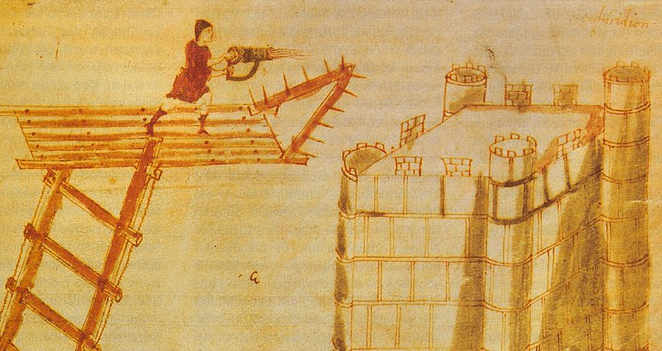
Greek fire originated in the east, and the oldest mention of it is by the Byzantines around 672. They used it mostly as a naval weapon and sprayed it as liquid from a syphon, which then burned, even on the surface of the water. Another name for it was “liquid fire”. Here’s an image from a 12th century chronicle depicting a 7th century Byzantine attack with Greek fire. It’s being sprayed on the enemy ship with a siphon.

Greek fire

Greek fire is depicted in medieval chronicles as an impressive tool. Knights from Europe first encounted Greek fire while on crusade. Here’s a vivid description from John de Joinville’s Chronicle of the Seventh Crusade: “the tail of fire that trailed behind it was as big as a great spear; and it made such a noise as it came, that it sounded like the thunder of heaven. It looked like a dragon flying through the air. Such a bright light did it cast, that one could see all over the camp as though it were day, by reason of the great mass of fire, and the brilliance of the light that it shed.”

a ceramic grenade for Greek fire

It could also be delivered in earthenware grenades, such as those used by Rafael. Here’s a picture of one of those ceramic grenades from the National Historical Museum in Athens. (Those are caltrops around it, an ancient Romance invention. They were scattered on roads to impede horses and foot soldiers. A caltrop always lands with one sharp point up.)

Greek fire could also be dispensed from a hand-held siphon called a chierosiphon, like the one in this illustration;

a chierosiphon for Greek fire

What was Greek fire? That’s a question people have been trying to answer ever since its use was first recorded! (It doesn’t help that crusaders used the name for all incendiary weapons.) It makes sense to look at Byzantine sources, since Greek fire originated there. Anna Komnene, a 12th century Byzantine princess, wrote a military history of Byzantium called the Alexiad, which includes this recipe: “This fire is made by the following arts: From the pine and certain such evergreen trees, inflammable resin is collected. This is rubbed with sulfur and put into tubes of reed, and is blown by men using it with violent and continuous breath. Then in this manner it meets the fire on the tip and catches light and falls like a fiery whirlwind on the faces of the enemies.

Here’s another quote from Anna Komnene, about the design of siphons to make the delivery of the flame more fearsome: “As he [the Emperor Alexios I] knew that the Pisans were skilled in sea warfare and dreaded a battle with them, on the prow of each ship he had a head fixed of a lion or other land-animal, made in brass or iron with the mouth open and then gilded over, so that their mere aspect was terrifying. And the fire which was to be directed against the enemy through tubes he made to pass through the mouths of the beasts, so that it seemed as if the lions and the other similar monsters were vomiting the fire.”

Like many secret formulae, Greek fire was said to contain many components and the secret of its manufacture was closey protected: each person involved in the production knew only the details of his own contribution. As a result, even when the Byzantines lost siphons or even the liquid in battle, their enemies failed to use Greek fire themselves – they were missing at least one element for success.

By the fourteenth century, though, I think it possible that a man like Rafael might have collected knowledge of the entire recipe. His plan to protect his area of expertise is to never share the secrets with anyone. That comes naturally to a man who seldom trusts anyone. Will he be able to keep all of his secrets once Ceara begins to compromise his own defenses? We’ll see!


The Dragon & the Damsel, book three of the Blood Brothers trilogy of medieval Scottish romances by Claire Delacroix

A mercenary convinced that each man must see to his own survival first, Rafael has learned to savor the moment and its pleasures. He is interested solely in conquest and coin, not any promise of the future—until an alluring maiden challenges him, defying him to stake a claim. Rafael cannot resist Ceara with her flame-red hair and keen wits, but their cat-and-mouse game takes a dangerous turn when Ceara is stolen by her kin. Rafael cannot stand aside when the damsel’s survival is at risk—though if she has stolen his shielded heart, she must never know of his weakness…

Ceara fled an arranged marriage, determined to wed for love or not at all. A horsewoman and huntress herself, she has encountered no man worthy of her affection—until she matches wits with Rafael, with his flashing eyes and seductive touch. She knows the handsome warrior seeks only one prize from her, but hopes to steal his heart. When she is captured and compelled to return to her betrothed, she is thrilled that Rafael lends chase. When he claims her as his own bride, Ceara dares to hope for more than a marriage of convenience.

But Rafael appears to be interested solely in conquest and passion, and their match becomes a battle of wills. Will Ceara be cast aside when her newfound spouse is offered the prize he desires above all else? Warrior and damsel, can these two wounded souls learn to surrender the truth of their hearts—before their union is shattered forever?

Coming September 20, 2022


Pre-order available at some portals:

Hawks & Hounds

I thought today we’d take a look at medieval hunting with hawks. Amaury, the hero in The Hunter & the Heiress, is an accomplished hunter. Elizabeth first sees him when he rides to hunt with his three dogs and his peregrine falcon, Persephone. Amaury’s dogs would be primarily be used to flush game, while the peregrine would take small birds. Amaury uses his crossbow for larger prey.

Hunting of large game was the privilege of the nobility in the medieval era. Deer and boar were specifically reserved for the sport of the aristocrats, but such large animals also provided for the lord’s table. In the forests on a lord’s holding, there would also be smaller game birds like grouse and partridge, as well as hares. The nobility also had the responsibility of hunting predators, like wolves, to ensure the safety of all.

This kind of hunting was also a nobleman’s occupation because of the cost of training and keeping the birds. The birds were kept in special buildings called “mews” in an established holding. The birds were hooded when not hunting because they are sight-hunters and this kept them more calm. They wore bells so they could be retrieved more readily when lost and jesses (leather straps) were tethered to their ankles so they could be held securely “on the fist”. The treatises below include a lot of recipes for medicines for the falcons, and a great deal of advice about keeping the birds healthy. We use “peregrine falcon” as a species, but in the MIddle Ages, “peregrine” referred to the female falcon, while “tiercel” referred to the male. Hunting was generally done with females. (The name “peregrine” derives from the practice of capturing the young birds while they were traveling to their breeding grounds rather than from the nest, since the nests were difficult to reach.)

Falconry characterizes medieval hunting to me. Like many other “pastimes’ of the nobility, it is a sport that allows military men to keep their fighting skills honed. Under the guise of providing for the table, they stalk, hunt and kill. Jousts and tournaments, also the reserve of the nobility, serve a similar purpose as well as providing for the defense of honor and entertainment.

The term falco peregrinus dates from Albert Magus’ use in 1225 but falconry is a much older sport than that. These specific raptors have been used in hunting for about 3,000 years. They are said to be easier to train than other hawks and also inclined to hunt. They circle above the falconer while game is flushed then dive to attack—the speed of descent can allow them to take down birds bigger than themselves. It’s also dramatic.

Frederick II, Holy Roman Emperor, (also called Frederick Barbarossa because of his red beard) lived from 1194 to 1250 and was by all accounts a remarkable man. He wrote a book on falconry called De Arte Venandi cum Avibus: “On the art of hunting with birds”. This book is based on Frederick’s own observations and experience and quite detailed. It’s a very personal guide to a sport he obviously enjoyed.

The Vatican has scanned their copy of this work and made it available for online viewing. You can find it here.

This is a screenshot of two of the pages with their lovely illustrations:

A scrren shot of the De Arte Venandi cum Avibus by Frederick II scanned by the Vatican

The Book of St. Albans from 1486 is a later work but one often quoted for its description of who should hunt with which kind of raptor.

Here is the University of Cambridge’s digitized version of The Book of St. Albans. I’ve linked you to the page where the listing begins (before that, the text concerns training and medicines as well as the keeping of hawks.)

“An Eagle for an Emperor, a Gyrfalcon for a King; a Peregrine for a Prince, a Saker for a Knight, a Merlin for a Lady; a Hobby for a Young Man; a Goshawk for a Yeoman, a Sparrowhawk for a Priest, a Musket for a Holy water Clerk, a Kestrel for a Knave.”

The fact that hunting was reserved to the nobility didn’t mean that common people had no meat to eat: they only had game when they ate at the lord’s table but they also ate meat that they had raised. Common people kept pigs—it was typical to get a suckling pig in the spring, feed it through the autumn, then slaughter it and have smoked pork products for the winter. They also kept geese and chickens as sources of both meat and eggs—so did the nobility—while rivers and ponds were used to raise eels (which could be smoked) and other fish. Fish was eaten on fasting days, when no meat could be consumed. Cows are less common in most areas in the Middle Ages, though goats were a source of milk (often for cheesemaking) as well as subsequently for meat. I’ve always suspected that medieval peasants also trapped rabbits in their vegetable gardens, and likely did have a little more game in their diets than the chronicles might suggest.


The Hunter & the Heiress, book two of the Blood Brothers series of medieval Scottish romances by Claire Delacroix

Nothing could be further from Amaury de Vries’ expectations than joining his half-brother’s company of mercenaries in the wilds of Scotland. A knight and a champion at the joust, he expected to inherit a holding—until the man he has known as his father revealed a terrible truth and disavowed him. Left with nothing, Amaury rides to Kilderrick, where he loses his heart to a beautiful noblewoman in the forest. A practical man, he knows he has no right to court the lady, but when she is abducted, Amaury follows, determined to fulfill his knightly duty by aiding a damsel in distress.

Elizabeth d’Acron has been a pawn and a prize, pursued for her father’s wealthy holding, and wants only to be desired for herself. Seized again, she vows she will surrender to no man—even the handsome knight who comes to her rescue. And truly, there could be no one more vexing than this confident yet inscrutable man, so concerned with duty that he could be wrought of stone—but Elizabeth soon learns that she can trust Amaury to defend her at any cost. She does not expect the seductive fire awakened by his touch, much less his conquest of her wary heart—but has she fallen in love with a man whose affections are already claimed?

Snared between duty and passion, Amaury finds himself beguiled by the lady who challenges his every expectation, but knows he has little to offer her. But when Elizabeth is threatened by a former suitor who will not be refused, Amaury risks his all in her defense, hoping it will be enough. But can he intervene in time? And will love alone convince Elizabeth to place her hand in his for all time?


Pre-order the ebook for February 15 delivery: