Fourteenth Century Armor

Today’s research post is about 14th century armor. In 1300, armor was mostly chain mail: by 1400, it had evolved to be mostly plate armor. How and when various warriors changed the style of their armor would depend upon where they lived and how affluent they were. My Blood Brothers series is set in 1375 so the armor worn by the knights and mercenaries in the story will be mixed.

We can look at the tomb of the Black Prince, which was made ca. 1386 for an idea of what was typical in that era. Edward the Woodstock, or the Black Prince, was the heir to the throne as son of Edward III – he died slightly before his father, though, in 1375 and was never king. (Edward III died in 1376.) An effigy of the Black Prince was cast of him arrayed for war – which had been his own request – and it remains at Canterbury cathedral, along with his gauntlets, shield and jupon. He was considered to be an admirable knight and a flower of chivalry. Although the effigy was created about ten years after his death, it is a precise replica of his armor – to the point that recently, it’s been concluded that an armorer was part of the team who created the effigy. (Here’s an article at the Smithsonian’s site about that.)

Most of the images I found online were copyrighted, so I’ll point you to this article at Atlas Obscura which has some good pictures. Hurry back. 🙂

You can see that Edward is wearing a mail collar (called an aventail) to protect his neck and shoulders, and there’s a glimpse of his mail hauberk beneath his surcoat from the side view. There would be a padded aketon beneath it. He wears a basinet of plate armor – his helm would go over this – and his gloves are reinforced with plate metal that covers the hands and wrists. These are called hour-glass latten gauntlets. Then there are more metal pieces to protect the fingers. (In the actual gloves, you can see the leather base where it survives.) His surcoat is embroidered with his insignia, quartered with the fleur-de-lis of the French crown and the three lions rampant of the Plantagenets. He wears plate armor greaves on his legs, sabatons on his feet and defences on his arms – and he has a moustache. 🙂 So, his armor is mostly plate, worn over the chain mail hauberk and with the addition of a mail aventail. The surcoat, which in the previous century fell to the knees and was called a tabard, is also shorter, falling just to the hip, and more fitted.

There is a British artist named Graham Turner who has doen many illustrations for books about armor. That link takes you to the website for his gallery, but you can also search for images by his name. There are many which show all of the elements of clothing and armor for a specific era.
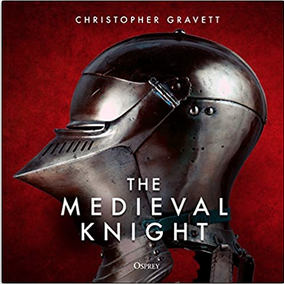
The Medieval Knight by Christopher Gavett

Here’s one of a Knight and equipment c. 1350 (this site licenses images to users but I’ll just point you to it). It’s included in a wonderful little book called The Medieval Knight by Christopher Gravett. (That’s an Amazon link.) The book has a lot of illustrations done by Graham Turner and they’re wonderful. You can see the developments in 40 years by comparing that image to this one, Knight and equipment c. 1390 – actually, the original prints of both of these images were available at the gallery and are still displayed on that site, along with Knight and equipment c. 1310. That page is right here. Click on the image to see it larger.

This knight (1390) wears a padded jupon over his armor with his insignia on it. You can see all the little ties and buckles which necessitated the services of a squire to fasten all around the back. The aketon and mail hauberk would still be worn underneath. The leg armor is now four pieces: the cuisse on the thigh, the poleyn over the knee, the greave on the shin and the sabaton on the foot. The belt with the scabbard for the sword and dagger is also worn much lower, around the hips. Around this time, armor starts to be modified for jousting, but we’ll talk about those developments next time.

My thinking that in the Silver Wolf’s company, only Amaury would have anything close to this full 1390 kit. He would keep it after leaving Château de Vries – of course! – but wouldn’t wear it all of the time. He’s trying to blend in with the company of mercenaries—at least until he escorts Elizabeth to her wedding and insists that they must “arrive in splendor” as a show of strength. As you might guess, Elizabeth will be a little dazzled by the man she’s previously seen as a huntsman when he appears in his full glory.

Next time, we’ll talk about Amaury’s (former) passion – jousting and tournaments.

The Hunter & the Heiress, book two of the Blood Brothers series of medieval Scottish romances by Claire Delacroix

Nothing could be further from Amaury de Vries’ expectations than being compelled to join a company of mercenaries in the wilds of Scotland, much less one led by his notorious half-brother. He chafes to return to his former life of privilege and knows a wealthy bride will allow him to regain his stolen legacy. Elizabeth is a prize unexpected—beautiful and an heiress—and when she is abducted by barbarians, Amaury’s path is clear. He may not be the sole contender for the lady’s hand, but he knows himself to be the best one—and he will use whatever means necessary to seal his triumphant claim.

All Elizabeth D’Acron desires is to wed for love, but her inheritance has made her both a pawn and a prize. Caught between warring chieftains, her defiance blossoms—she chooses instead to flee with Amaury and make a marriage of convenience, hoping her trust in the gallant knight is not misplaced. She does not expect the beguiling fire awakened by Amaury’s touch, much less his unexpected conquest of her heart, and she dares to hope that true love has found a way.

But Elizabeth’s legacy is not so readily claimed—when Amaury’s plan is revealed, she is shattered to learn that her chivalrous husband is no different from other men. Recognizing that the true prize is his lady wife, Amaury rejoins the company of mercenaries and leads the battl to ensure Elizabeth’s freedom, whatever the cost to himself. Can these two lovers overcome the wounds of the past to build a future together? Or will the secret behind Elizabeth’s inheritance destroy any such hope forever?

Coming in January 2022!


The Hunter & the Heiress will ba availble in wide distribution for one week after publication, then it will be exclusive to Amazon and enrolled in Kindle Unlimited.


Pre-order available at some portals:

The Hunter & the Heiress, book two of the Blood Brothers series of medieval romances by Claire Delacroix, audio edition

The Hunter & the Heiress will also be available in an audio edition, narrated by Tim Campbell.

Beaupoint and Hadrian’s Wall

Once again, I’m sharing some of my medieval research with you for The Hunter & the Heiress. Last week, we talked about the Siege of Caerlaverock and insignia of medieval knights. This week, we’ll cross the Solway Firth to look at the history that inspired the fiction of Elizabeth’s home, the fictional Beaupoint.

One of the most remarkable resources surviving from 14th century England is called Gough’s Map. This map was completed around 1390 and is one of the earliest attempts to document the reality of the land, for navigation and travel. Previously, mapmakers were more interested in showing the relationship between territories and Jerusalem, or the evidence of the divine in the material world. (Check out my previous post Seven Medieval Maps. Gough’s Map is there, too.) Naturally, it has more detail further south and gets a big vague in Scotland, but it’s still a very useful resource. Here’s an image of the whole map from the Bodleian Library’s website:

Gough Map from the Bodleian Library

You’ll notice right away that the orientation isn’t what you might expect. North is to the left, and south to the right. The map is drawn upon two pieces of vellum, which are seamed in Scotland.

The map is owned and maintained by the Bodleian Library (you can see in the image above that it’s stretched out) but they’ve made a digital (and searchable) version available of the map online right here. What’s really cool about this map is that you can search by modern location name, and in the little box at the top right, you can select details to be highlighted. If you choose Settlements, for example, a number of yellow dots appear on the map. When you hover over one, a question mark appears – click it and you’ll get the information from the map about that location. This tells us what settlements were established in the 14th century, which is pretty cool.

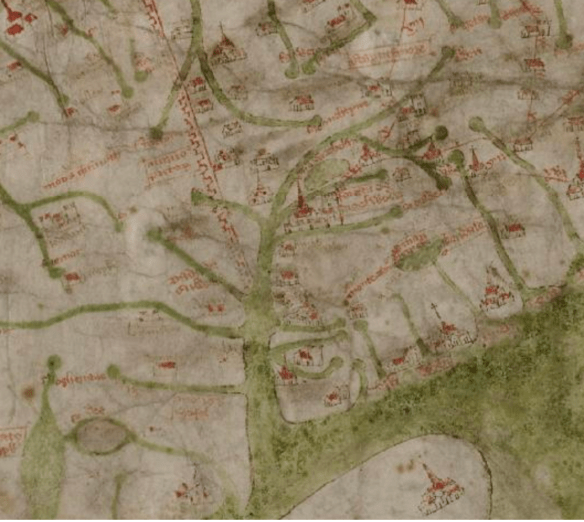
If you start at that seam and look to the right, you’ll see an estuary that indents toward 2 o’clock. That’s the Firth of Clyde. Carry on to the right and opposite an island (just past the notch in the bottom edge of the map) is an estuary that goes straight up and forks like a tree. This is the Solway Firth. That big island is the Isle of Mann. I took a detail shot of this area, since it’s where we want to be.

detail image of the Gough Map from the Bodleian Library website

This is Solway Firth. You can see Hadrian’s Wall extending (east) toward 11 o’clock. Two rivers down from that, there’s a small red dot on the peninsula. This is Caerlaverock. Dumfries is the rectangle to the left of it. The church on the opposite side of the firth and slightly west (down) is Workington; at its 1 o’clock is Cockermouth. The big red church above them is Carlisle, and between Workington and Carlisle, there are four settlements marked: west to east (bottom to top) they are Holme Abbey, Kirkbride, Bowness and Burgh-by-Sands. Hermitage, the inspiration for Kilderrick, is also marked on the map – if you start up Hadrian’s wall, there’s a dark stain to the left between the sources of two rivers. The red mark for Hermitage is there. Just FYI, the two marks on the first peninsula on the left/north of the wall are unlabelled on the map. The right one must be Annan, the mote-and-bailey ca. 1160 which was abandoned by this time – because the route of the river changed – and the left one could be Lochmaben Castle, rebuilt by Edward I around 1300.

Hadrian’s Wall was in ruins in many sections by this time, not just having eroded by time and weather, but because stones were taken from it and reused. We know that the wall originally extended along the south side of Solway Firth, via Carlisle, continuing to Bowness, but the Gough Map shows it ending at the firth. This appears to be speculation about Scotland. 🙂

Here’s a screenshot of that section of Hadrian’s Wall, from the interactive map on the National Trails website, on the pages about the Hadrian’s Wall Trail. The trail is turquoise. (You can find that page, with a lot of great information about hiking the trail, right here.)

Hadrian's Wall path near Solway Firth

We can see the wall passing north of the original center of Carlisle, then continuing to Beaumont, Burgh-by-Sands, Drumburgh and finally Bowness on Solway. Across the firth is Annan. The marshes to the north and west of Burgh-by-Sands are shown here, as well—while rivers and their silt deposits change over time, the name of Burgh-by-Sands indicates that there was always a gathering of silt there. The marshes were there in the 14th century, too, because Edward I drowned in the Burgh Marshes in 1307 on his way to fight Robert the Bruce in Scotland. He laid in state in the church at Burgh-by-Sands and his momument is there. (It’s also marked on this map.) The town name also tells us that the church was fortified. There are some pictures of St. Michaels Church in Burgh-by-Sands on the Cumbria tourist site, right here.

But Beaumont is on this map, too, and this is one of our destinations today. On the Gough map, Beaumont would be between Carlisle and the first dot below it, Burgh-by-Sands. It’s not marked as a settlement, probably because it wasn’t one anymore by the 14th century. There had been a Norman motte-and-bailey keep built over a milestone lookout on Hadrian’s Wall, but in the 12th century, St. Mary’s church was built on the site instead. There are pictures of the church on that same Cumbria tourist site, right here, and you can see that it’s on a rise, which offers a view over the firth. The name itself means “beautiful hill” and the Hadrian’s Wall site makes note of the view to both the north and south.

Why was Beaumont changed from a keep to a church? I suspect the holding was simply too small to justify a keep of its own, particularly if the lord had larger holdings. Beaumont was historically held by the Brun family, who were lords of Bowness and also the patrons of St. Mary’s church. I found some geneology records which referred to a Richard le Brun (ca. 1300) holding Drumburgh, Bothel, Beaumont and Bowness. He was made a knight of the shire of Cumberland in 1307 and granted a license to crenulate Drumburgh in 1307. (Here’s an article about the pele tower in Drumburgh dating from 1307, which survives.) That would have been his main holding, then, if he wanted to fortify the structure. Throughout the 13th century, there are scattered earlier records of the family, listed as lord of Bothyl, bailiff of Egremont and steward of Coupland – another was sheriff of Carlisle. This was a powerful and affluent family, although in the fourteenth century, some of their holdings passed to the Dacre family. Drumburgh Castle was rebuilt (after disintegrating into partial ruin) before 1518 by Thomas Dacre.

The importance of Drumburgh lay in its location, near a popular ford over Solway Firth. These fords were called “waths” and were accessible at low tide. There were probably many waths, but this blogger has posted a map showing four: the Sulwath across the river Esk, the Peatwath across the river Eden, the Sandywath from Drumburgh to Dornock, and the Bownesswath, crossing firth from Bowness to Seafield. The waths were a way to get from England to Scotland without detection on the roads. (This explains why King Edward was in the marshes in the first place and why the Romans had so many lookouts on the south coast of the firth.)

Elizabeth’s fictional family holding in The Hunter & the Heiress is called Beaupoint and it was inspired both by Beaumont and Drumburgh. (So was her surname D’Acron.) Beaupoint is the site of a fictional and popular wath, defended on both sides – and her value as heiress of Beaupoint lies in the strategic importance of her family holding, as well as the wealth of her father’s treasury. It’s a keep rich in history, with Roman ruins underfoot. Her family has ties to the English crown, but also has historically switched sides for advantage. You can readily imagine how a woman raised in such privilege might not only insist upon having her own choice, but would be shocked by her situation when everything goes awry.


The Hunter & the Heiress, book two of the Blood Brothers series of medieval Scottish romances by Claire Delacroix

Nothing could be further from Amaury de Vries’ expectations than being compelled to join a company of mercenaries in the wilds of Scotland, much less one led by his notorious half-brother. He chafes to return to his former life of privilege and knows a wealthy bride will allow him to regain his stolen legacy. Elizabeth is a prize unexpected—beautiful and an heiress—and when she is abducted by barbarians, Amaury’s path is clear. He may not be the sole contender for the lady’s hand, but he knows himself to be the best one—and he will use whatever means necessary to seal his triumphant claim.

All Elizabeth D’Acron desires is to wed for love, but her inheritance has made her both a pawn and a prize. Caught between warring chieftains, her defiance blossoms—she chooses instead to flee with Amaury and make a marriage of convenience, hoping her trust in the gallant knight is not misplaced. She does not expect the beguiling fire awakened by Amaury’s touch, much less his unexpected conquest of her heart, and she dares to hope that true love has found a way.

But Elizabeth’s legacy is not so readily claimed—when Amaury’s plan is revealed, she is shattered to learn that her chivalrous husband is no different from other men. Recognizing that the true prize is his lady wife, Amaury rejoins the company of mercenaries and leads the battl to ensure Elizabeth’s freedom, whatever the cost to himself. Can these two lovers overcome the wounds of the past to build a future together? Or will the secret behind Elizabeth’s inheritance destroy any such hope forever?

Coming in January 2022!


The Hunter & the Heiress will ba availble in wide distribution for one week after publication, then it will be exclusive to Amazon and enrolled in Kindle Unlimited.


Pre-order available at some portals:


The Hunter & the Heiress, book two of the Blood Brothers series of medieval romances by Claire Delacroix, audio edition

The Hunter & the Heiress will also be available in an audio edition, narrated by Tim Campbell.
Blood Brothers Character List

The Wolf & the Witch, book one of the Blood Brothers trilogy of medieval Scottish romances by Claire Delacroix

There’s a new page under the Blood Brothers tab, which is a character list. This is a work-in-progress and currently updated through The Wolf & the Witch. If you haven’t read that book yet, there may be spoilers!

You’ll find the Blood Brothers Character List here.

The Siege of Caerlaverock

At the end of The Wolf & the Witch (and the beginning of The Hunter & the Heiress), Elizabeth has been seized by two men seeking the bounty that will be paid by her betrothed, Calum Moffatt, upon her delivery to him at Caerlaverock castle. Amaury pursues this small party from Kilderrick, with the squire Oliver, intent upon defending Elizabeth. We know that she fled this arranged marriage, but Amaury doesn’t know that part of her story yet.

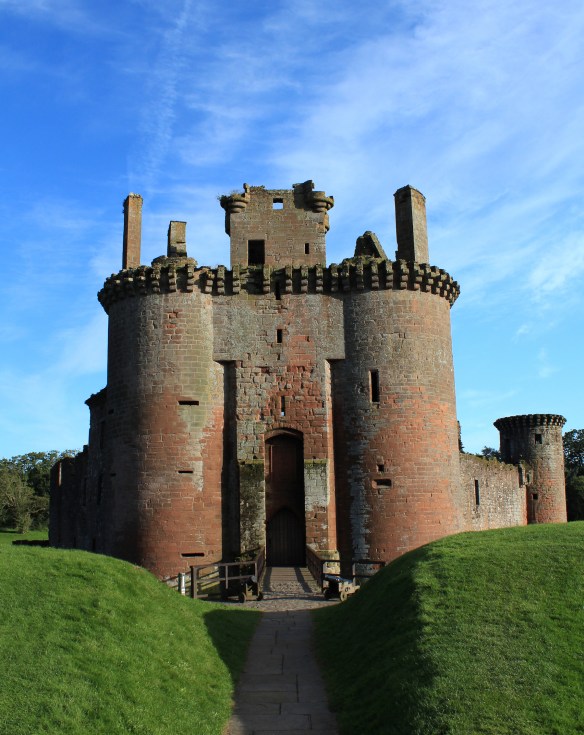
Today, I thought we’d take a look at Caerlaverock castle, which is built on a site that has been fortified for centuries. There was a Roman fort on Ward Law Hill and a British hill fort around 950 AD. The site allowed a view over Solway Firth. The name Caerlaverock appears in 1160 when the lands were granted to the Cistercian monks of Holm Cultram Abbey in Cumbria (across the firth). They held and rented lands in Galloway and used stone from there to built their abbey, but their grasp on these holdings steadily eroded. Interestingly, they were attacked by Scots, including Robert the Bruce in 1319, despite the fact that his father was buried in the chapel.

Caerlaverock Castle
Caerlaverock Castle, Dumfries, Scotland

The lands of Caerlaverock were granted to Sir John Maxwell in 1220 by King Alexander II, sealing its association with the Maxwell clan. Sir John Maxwell began construction on the first castle, which was square in shape with a moat, in the 1220’s. That castle and site was abandoned (possibly incomplete) in favor of a rise some 200 feet to the north, where the triangular moated castle was built by Sir Aylmer Maxwell—it was complete in 1271.

Caerlaverock Castle
Caerlaverock Castle

In this image, you can see the curtain walls that survive from the 14th century and the view over the Solway Firth. It’s likely that the walls were built from the stone excavated to dig the moat. The keep is also surrounded by earthworks. There are 17th century additions inside the walls called the Nithsdale Lodging.

Here’s the website for Caerlaverock Castle from Historic Environment Scotland.

What is interesting for my story is that the castle was besieged in July 1300 by King Edward I of England with an army of knights. Ultimately the castle was compelled to surrender, but there was a poem composed in Old French, called the Siege of Caerlaverock (or the Roll of Caerlaverock) which lists the attending knights, their credentials and standards, as well as describing the battle itself. 87 knights accompanied Edward to this battle, so it’s quite a list.

It starts like this:

In chronicles of great monasteries
It is found that King Edward the Third,[1]
In the year one thousand three hundred
Of grace, on the day of Saint John,
Was at Carlisle, and held a great court,
And commanded that in a short time
All his men should prepare themselves,
To go together with him
Against his enemies the Scots.
Before the appointed day
The whole host summoned was ready;
And the King with his great household
Immediately set forward against the Scots,
Not in coats and surcoats,
But on powerful and costly chargers,
In order that they might not be taken by surprise,
Well and securely armed.
There was many a rich caparison
Embroidered on silks and satins;
Many a beautiful pennon fixed on a lance;
And many a banner displayed.
And afar off was the noise heard
Of the neighing of horses;
Mountains and valleys were everywhere
Covered with sumpter horses and waggons,
With provisions, and the train
Of the tents and pavilions.
And the days were fine and long,
So they proceeded by short journies,
Arranged in four squadrons;
The which I will describe to you,
That I will not pass one over.
First I will tell you of the companions,
All their arms and names,
Especially of the bannerets,
If you will listen how.

Henry the good Earl of Lincoln,
Who embraces and loves valour,
And holds i sovereign in his heart,
Leading the first squadron,
Had a banner of yellow silk
With a purple lion rampant

(That first footnote notes that the chronicler believed Edward I to be the third Edward who had reigned over England, counting Edward the Elder and Edward the Confessor.)

In this era, the use of insignia was comparatively new and unregulated. There were already certain elements associated with royal families – fleur-de-lis for the French king, or on azure, three leopards rampant for the English king, gold on gules, and ermine for the Kings of Brittany – but many knights simply chose their colors. An incident like this one described later in the poem was thus possible:

Brian le Fitz Alan, saw I,
full of courtesy and honour,
barry gold and gules
displaying in a very splendid banner. 
this the same as Hugh Pointz carried —
difference there was none at all —
which was cause of strife between them,
and a marvel to men all.

Oops.

Here‘s the Wikisource of the poem, from which I took the first excerpt as it’s in the public domain. Some of the poem is presented in a side-by-side translation from the Old French to English, and there are some illustrations of the standards.

Here‘s an English translation of the text with illustrations of all the described standards at the Heraldry Society. The second excerpt came from there.

This is a fascinating chronicle for its detail, but also, in terms of story, I’m sure Amaury is familiar with it. He has a love of pageantry and heraldry, given his history of jousting in tournaments. He’s attended royal courts and heard the troubadours sing, and this poem recounting deeds of knightly valor, would certainly be one he’d find appealing. It’s evocative of the life he expected to life, and also the one Elizabeth abandoned for the sake of having her own choice. Amaury had an insignia, but of course, he was disavowed by Gaston de Vries, the man he believed to be his father, at Jean le Beau’s funeral at the beginning of The Wolf & the Witch. He had been hoping to ride to Paris to tourney (check on a stallion and a noble maiden), so I have to think he had all his trappings with him. He would have packed them away, not discarded them, because of their cost. At Caerlaverock, he will have use for them again – which means I had to design his insignia.


The Hunter & the Heiress is the second book in my Blood Brothers series and will be published in January 2022.

The Hunter & the Heiress, book two of the Blood Brothers series of medieval Scottish romances by Claire Delacroix

Nothing could be further from Amaury de Vries’ expectations than being compelled to join a company of mercenaries in the wilds of Scotland, much less one led by his notorious half-brother. He chafes to return to his former life of privilege and knows a wealthy bride will allow him to regain his stolen legacy. Elizabeth is a prize unexpected—beautiful and an heiress—and when she is abducted by barbarians, Amaury’s path is clear. He may not be the sole contender for the lady’s hand, but he knows himself to be the best one—and he will use whatever means necessary to seal his triumphant claim.

All Elizabeth D’Acron desires is to wed for love, but her inheritance has made her both a pawn and a prize. Caught between warring chieftains, her defiance blossoms—she chooses instead to flee with Amaury and make a marriage of convenience, hoping her trust in the gallant knight is not misplaced. She does not expect the beguiling fire awakened by Amaury’s touch, much less his unexpected conquest of her heart, and she dares to hope that true love has found a way.

But Elizabeth’s legacy is not so readily claimed—when Amaury’s plan is revealed, she is shattered to learn that her chivalrous husband is no different from other men. Recognizing that the true prize is his lady wife, Amaury rejoins the company of mercenaries and leads the battl to ensure Elizabeth’s freedom, whatever the cost to himself. Can these two lovers overcome the wounds of the past to build a future together? Or will the secret behind Elizabeth’s inheritance destroy any such hope forever?

Coming in January 2022!


The Hunter & the Heiress will ba availble in wide distribution for one week after publication, then it will be exclusive to Amazon and enrolled in Kindle Unlimited.


Pre-order available at some portals:


The Hunter & the Heiress, book two of the Blood Brothers series of medieval romances by Claire Delacroix, audio edition

The Hunter & the Heiress will also be available in an audio edition, narrated by Tim Campbell.

The Wolf & the Witch into Kindle Unlimited

The Wolf & the Witch was enrolled in Kindle Unlimited this morning through February. If you’re a KU subscriber, you can read Maximilian and Alys’ story free!


The Wolf & the Witch, book one of the Blood Brothers trilogy of medieval Scottish romances by Claire Delacroix

Denied his rightful legacy, Maximilian de Vries devised a plan to avenge himself upon his father and see his own future secured. Allied with his two half-brothers, he descends upon ancient and mysterious Kilderrick, determined to seize the keep once promised to him, regardless of the price. A woman rumored to be a witch is the sole one bold enough to defy him but Maximilian has a solution—he will take her to wife, whether she be willing or nay, and seal his claim.

But this powerful warrior has yet to match wits with Alys Armstrong, a maiden with a thirst for vengeance and a fury that might exceed his own. Alys has no intention of capitulating to the proud and powerful rogue who stole everything from her—no matter how seductive his touch might be—and she does not share his compulsion to fight fair.

Bitter enemies from the outset, Maximilian and Alys’ match is a battle of wills. When passion flares, will either of them be able to resist temptation? And when Kilderrick itself is in peril, will they join forces to save the holding they each prize—and the unexpected love they value above all else?


Five star review for The Wolf & the Witch, book one of the Blood Brothers series of medieval Scottish romances by Claire Delacroix

Here’s a blog post about my inspiration for Kilderrick.


Here’s a blog post about William II de Soulis, inspiration for Robert Armstrong.


Here’s a blog post about 14th century mercenaries
– like Maximilian, Jean le Beau and Rafael.


Here’s a blog post about King Robert II of Scotland,
the reigning monarch during this series.


Here’s a blog post about “poppy powder”.


Five star review for The Wolf & the Witch, book one of the Blood Brothers series of medieval Scottish romances by Claire Delacroix

The Wolf & the Witch is exclusive to Amazon and enrolled in Kindle Unlimited through February 2022.


Buy the ebook: