William II de Soules

I promised you another post about my inspiration for The Wolf & the Witch, but things got away from me. The last two months have been hectic, but I’m catching up.
The Wolf & the Witch, book one of the Blood Brothers trilogy of medieval Scottish romances by Claire Delacroix

In The Wolf & the Witch, the father of the heroine, Alys, was Robert Armstrong. He died when she was a child (no spoilers from me!) but had a reputation as a man who had made a deal with a demon. She reveals that he had lost a great deal before he died himself: her mother had died in childbirth, so he was a widower; he had made some poor decisions in administering his holding and household, so had no servants or villeins any longer; he had been robbed of all his wealth and his treasury was empty; and finally, he was reputed to have made a deal with a demon of the classic one-soul-for unlimited-power variety. (Why he would have been in such dire straits after making such a deal is another question altogether.) The ruin of Kilderrick is said to be haunted by a redcap goblin, which was Robert’s familiar – a detail that Alys uses to advantage to keep intruders away. In the course of the story, Alys realizes a few key truths about her father.

But the point of this post is to share my inspiration for Robert, which was William II de Soules. (I’ve already posted about Hermitage Castle being the inspiration for fictional Kilderrick.) William was a nobleman in the fourteenth century who held Hermitage castle and died in 1321. Like the fictional Robert, William had a considerable reputation, not all of which was true.

Let’s go back a bit. The first William de Soules was a Scottish nobleman granted the holding of Liddesdale by the Scottish king, and Butler of Scotland. His son, Nicholas de Soules, inherited the holding and the titles upon his father’s death around ???. When Margaret, the Maid of Norway, died in 1290, Nicholas was one of the contenders for the Scottish crown—the story was that his grandmother had been an illegitimate daughter of King Alexander II. His quest for the throne did not succeed and in 1296, he pledged homage to Edward I of England. He and his wife, Margaret Comyn, had two sons, William and John.

Nicholas’ son, William (II), was received into the peace of England by Edward I in 1304. He remained in the service of the English until Robert the Bruce’s victory at Bannockburn in 1314—then he changed his allegiance back to Scotland. He became Butler of Scotland, like his father and grandfather, but then, in 1320, was part of a plot challenging Robert the Bruce. It seems likely that the old idea of the de Soules line having a claim to the throne might have been behind this. The plot was found out and William arrested at Berwick. He confessed to his treason at the Black Parliament of 1320, but the king spared his life, making his considerable lands forfeit instead. William was imprisoned in Dumbarton Castle, where he died in 1321, leaving a daughter and heiress, Ermengarde.

The rumors about William are far more interesting! He was reputed to be a sorceror, tutored by the famous (dead) magician, Michael Scot. William could not be bound with ropes, injured by steel or killed by ordinary means because of his powers. He was large and cruel, seizing children for his blood rites and terrorizing both his vassals and his neighbors. He was said to have fortified his fortress, Hermitage Castle, against the king using supernatural means. (Even so, it wasn’t the castle that we recognize on that site: the castle that survives is a remnant of the fortification build by the Earl of Douglas after the holding was forfeited by Soules.) William’s abused vassals complained repeatedly to the king, Robert the Bruce, who is dismissive of their concerns in these stories, telling them “Boil him, if you please, but let me hear no more of him.”

And so, they do. The villagers have a chain forged to restrain the large and powerful William. He is taken forcibly to the Ninestang Ring and boiling him in molten lead. The story continues that Hermitage Castle sank into the ground after the passing of its lord, and that the keep is haunted still by William’s familiar, Robin Redcap.

There is a ballad about William called Lord Soulis composed by J. Leyden and included by Sir Walter Scott in his Minstrelsy of the Scottish Border. (It’s in Volume IV). It ends like this:

At the Skelf-hill, the cauldron still
The men of Liddesdale can show;
And on the spot, where they boil’d the pot,
The spreat and the deer-hair ne’er shall grow.

I didn’t have nearly enough fun with Robin Redcap in The Wolf & the Witch, but we’ll see more of him in The Scot & the Sorceress. I think Nyssa knows a lot more about goblins and hauntings than I do—and more than Murdoch would like to believe.
First Review for The Wolf & the Witch

And it’s five stars! Yay!

Five star review for The Wolf & the Witch, book one of the Blood Brothers series of medieval Scottish romances by Claire Delacroix

It was such a great review that I made two memes from it. (Thank you Naomi!)

Five star review for The Wolf & the Witch, book one of the Blood Brothers series of medieval Scottish romances by Claire Delacroix

You can read an excerpt here.


The Wolf & the Witch, book one of the Blood Brothers trilogy of medieval Scottish romances by Claire Delacroix

Denied his rightful legacy, Maximilian de Vries devised a plan to avenge himself upon his father and see his own future secured. Allied with his two half-brothers, he descends upon ancient and mysterious Kilderrick, determined to seize the keep once promised to him, regardless of the price. A woman rumored to be a witch is the sole one bold enough to defy him but Maximilian has a solution—he will take her to wife, whether she be willing or nay, and seal his claim.

But this powerful warrior has yet to match wits with Alys Armstrong, a maiden with a thirst for vengeance and a fury that might exceed his own. Alys has no intention of capitulating to the proud and powerful rogue who stole everything from her—no matter how seductive his touch might be—and she does not share his compulsion to fight fair.

Bitter enemies from the outset, Maximilian and Alys’ match is a battle of wills. When passion flares, will either of them be able to resist temptation? And when Kilderrick itself is in peril, will they join forces to save the holding they each prize—and the unexpected love they value above all else?


Get your copy at these portals:


The Wolf & the Witch will also be published in trade paperback, in a hardcover large print edition and in audio. Stay tuned for more links!


Pinterest Board for Blood Brothers

I’ve been working on the Pinterest board for the Blood Brothers series and have just made it public. I’ll still be adding more pins, especially for the later books, but you can have a browse now.

This graphic mingles all the pins, but if you click through, you’ll see that they’re organized by book.

Schedule Updates

The Wolf & the Witch, book one of the Blood Brothers trilogy of medieval Scottish romances by Claire Delacroix

If you have pre-ordered The Wolf & the Witch, you may have received an update from your portal of choice that the publication date has been changed. Maximilian and Alys’ story will now be published on May 11. As has so often been the case with my pre-orders, the final compilation of the book is just a little too tight, so I’ve added those two weeks to make sure everything is right.

There’s an excerpt on the book’s landing page, so you can have a peek.

If you haven’t pre-ordered The Wolf & the Witch, you can do so at these portals:

Deadlines are tricky for me. An approaching deadline can pull parts of the story into focus more quickly than they might become clear to me otherwise. Too much deadline pressure can undermine my creativity completely. There’s a balance to be struck, probably one I learned when I was traditionally published. I’ve tried to mimic that with pre-orders, but haven’t managed to get the balance right. As a result, in future, my books will be available for pre-order only when they are completely written, edited and formatted.

As a result of that decision, I’ve also removed the pre-order for One Knight’s Desire, which had been scheduled for publication this fall.

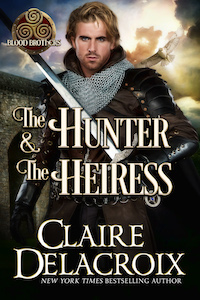
The Hunter & the Heiress, book two of the Blood Brothers series of medieval Scottish romances by Claire Delacroix

A number of other considerations also contributed to that choice, the first being that fewer of you are interested in medieval Burgundy than I am. The second is that series perform better when books are published more rapidly in sequence. As much as I love switching between eras and series, it’s not a good publishing decision.

The next book I write and publish will be The Hunter & the Heiress, book two in the Blood Brothers series. I’m hoping to publish that story in the fall. My plan is to finish that series before thinking about Sayerne or any other series again.

Inspiration for Kilderrick

The Wolf & the Witch, book one of the Blood Brothers trilogy of medieval Scottish romances by Claire Delacroix

When I began to plan for my Blood Brothers trilogy, I wanted to visit some new territory, so to speak. I’ve written books set in medieval France and England—as well as less conventional settings, like Persia—and my Scottish medievals begin at Ravensmuir, inspired by Tantallon to the east of Edinburgh. My Scottish medieval family at Kinfairlie had links to the throne and to France, and their background was Norman. Ultimately, they married into families from the Highlands. The Rogue begins in 1371 and The Beauty Bride in 1421: I like to stay clear of the years that the black plague was in Scotland, 1349-50 and 1362. In my Champions of St. Euphemia series, Fergus returns home from Crusade to Galloway in 1188 in The Crusader’s Vow, while in The Beauty, Alasdair has returned home from Crusade to the Highlands in 1183, which sets those stories on the other side of the plague.

The heroes in the Blood Brothers series are warriors and sons of a successful mercenary. Mercenaries—or blades-for-hire—existed throughout the Middle Ages, actually even longer than that. They traveled to wherever there was a battle, hiring themselves and their companies out to the highest bidder. They were particularly successful before kings established standing armies, because their services were needed by those kings – it was true that vassals owed military service or knights to their overlords or king, but these men weren’t always as well equipped, trained or sufficiently numerous. In the fourteenth century, mercenaries proliferated in Europe – some were nobly born, some weren’t, and they tend to be left out of the chronicles. I like the sons of mercenaries as heroes: they are often conflicted about their legacy and their livelihood, which makes them ideal candidates for the Beauty-and-the-Beast stories I so love to write.

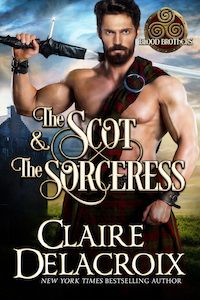
The Scot and the Sorceress, book two of the Blood Brothers trilogy by Claire Delacroix

I chose the titles for the books because of their alliteration, and because they reminded me of the titles of historical romances when I first started to read these books. I loved those sweeping stories, filled with history and passion, and that was what I intended this series to be like. (And yes, the swishy type is a bonus.) Since the heroes were warriors, the women needed to have some abilities of their own: the first two heroines are called Witch and Sorceress, but I knew that would only be their cover story to keep unwanted suitors and intruders away. I envisioned them like the witches in MacBeth, surviving on the edge of the wilderness, fiercely independent and fearless.

This series was to be set in Scotland and I was fascinated with the Border Reivers who operated on the Western Marches. Although these border raiders operated from the thirteenth to the sixteenth centuries, most of the stories about them are from the later period, and I expected this series to be set in the late fifteenth or even the sixteenth century. I had mixed feelings about this era, but liked the idea of my heroines being rebels who were indifferent to authority.

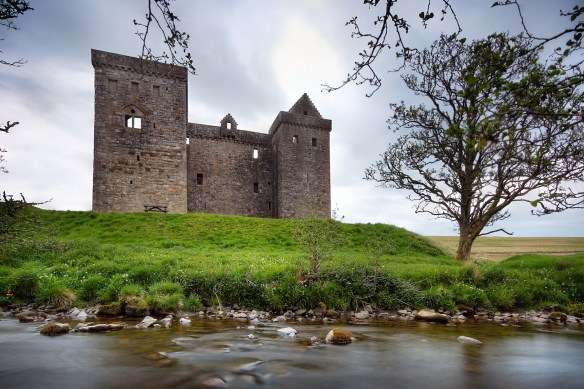
Then I dug into my research and—as is so often the case—the pieces fell into place, as if by magic. It seemed as if I’d brought together the perfect combination of elements. Liddesdale is a valley to the north and east of Carlisle, notorious as a retreat for reivers, with a large forest to the east which is today preserved as the Border Forest Park. South of this park, Hadrian’s Wall remains. At the north end of the Liddesdale valley is a castle ruin at Hermitage.

The ruins of Hermitage Castle on the Scottish Borders

Many of the medieval stone buildings in the area frequented by the reivers are fortified towers, but this is a fortress. Hermitage is said to derive from the French l’armitage or guardhouse and this keep was called “the strength of Liddesdale”. The original structure was built in 1240 by Nicholas de Soulis and was a motte-and-bailey keep. In 1320, his descendant William de Soulis was said to have practiced witchcraft and/or been a magician who could not be harmed by steel or rope. He terrorized his tenants and the story is that they rose up and boiled him in molten lead in a nearby stone circle called Ninestang Ring. The keep is said to be haunted by his familiar, Redcap Sly, and that story was recorded by Sir Walter Scott in his Minstrelsie of the Scottish Border. (We’ll talk more about this next week.) It’s a great story, but William was actually imprisoned by his overlord and died imprisoned in Dumbarton Castle. The current structure, imposing even in ruin, was built by the Earl of Douglas in the late fourteenth century, likely with the services of John Lewin, the master mason from Durham Cathedral.

The ruins of Hermitage Castle on the Scottish Borders

And so, I have a fourteenth century story inspired by historical events: I now know that the mercenary (and son of a mercenary) Maximilian burned Kilderrick, the motte-and-bailey keep held by Alys’ father, at his own father’s command. Hermitage is the inspiration for Kilderrick, making Alys the sole survivor of a family experienced in border raiding (as the Armstrongs were said to be). Of course, she remembers the fire and blames Maximilian for everything she’s lost. Of course, Maximilian will be the one to build the new keep in stone when he returns to claim the holding – he’ll want to ensure that it is a fortress that can never be taken from him, as his rightful legacy has been. We’ll miss the plague of 1365, although both protagonists remember its ravages. Maximilian arrives at Kilderrick in 1375, fifteen years after he left it smoldering. England and France have signed the Truce of Bruges that will last only until 1378—which means Maximilian will be able to travel from Normandy to Scotland with comparative ease. The Scots and the English will ride to war in 1384, although both sides were already making preparations for the inevitable conflict, which is why Maximilian will be able to secure the financing for construction from the Earl of Douglas in exchange for his alliance.

Is there a ghost in the ruins? Alys would like Maximilian to think so—and as Maximilian’s unwilling bride, she has the ways and means to make her husband doubt his own sanity, as well as the motivation to do so. (Enemies-to-lovers stories are so fun.)

Next week, we’ll talk about the story of William Soulis.

Learn more about The Wolf & the Witch.