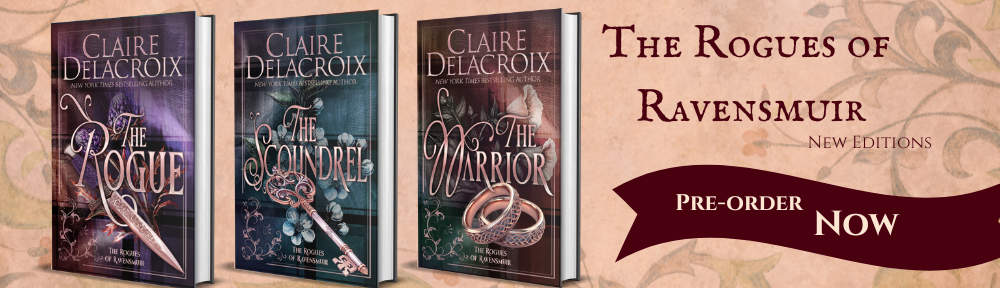
Taking a character who has been a villain in one book, then making him the hero in his own book is a challenge I enjoy. It only makes sense to me that if love can conquer all, it can also reveal the hidden goodness in a character and redeem him. (I’ve never done this for a heroine, though. Hmm.) The thing is that these books, which are tough to write, invariably turn out to be among my favorites of my own books.
My first decision to do this was with Gawain, the wicked brother of Merlyn in The Rogue. Gawain was trouble but he also had a certain charm, along with his disregard for anyone other than himself. He was a clever character, raised to be the thief he was, and very good at his so-called profession. I thought of him as kind of a James Bond character, which prompted me to look deeper, since James Bond has a history that drives his choices.
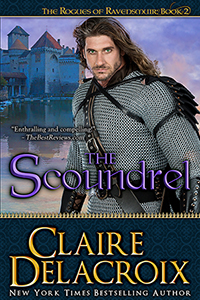
I also thought Gawain was due for a surprise. He was accustomed to things going exactly the way he planned them. What would unexpected challenges do to this confident thief? What about being bested by someone else? Enter Evangeline, an unhappy heiress determined to change her future, and prepared to do whatever is necessary to make it so—including seducing a thief and stealing a prize from him. Repeatedly. Their book is The Scoundrel. I loved these two together and how Evangeline compelled Gawain to discover his lost honor. Here’s the moment that Gawain realizes what’s happened:
It was remarkable, for I could have spent a pleasant night betwixt the lady’s thighs, but had denied my own pleasure to protect her heart.
—from The Scoundrel
Chivalry, which I had long believed to be dead and gone from this world unlamented, had proven to be hidden in the most unlikely of places—it had been nestled in my very marrow, and had revealed itself at a most inconvenient time.
I saw now why I had always avoided noble deeds—I had slept alone, awakened alone, been relieved of my valuables, and all because of my own misguided urge to warn the lady away from me. Gallantry, in my opinion this morn, was of less merit than most men believed.
I redeemed a couple of heroes on my Cooke brand next, including the happy-go-lucky and indulged youngest son in the Coxwell family, in All or Nothing. Zach has the ability to make Jen laugh, something she’s forgotten in her battle with breast cancer. She’s learned her lesson about handsome guys with easy charm, though—and how quickly they jump ship when things get tough—so Zach digs in to prove her assumptions wrong. Along the way, he learns that there’s something (or someone) he cares about after all, though Jen isn’t easy to convince. I love their story, too. 🙂
My next “villain” to be redeemed was really an outsider. Lorenzo in the Dragonfire Novels has no interest in being a dragon shifter, so doesn’t want anything to do with his kind. He’s built a life as an illusionist and he doesn’t need the distraction of the Pyr war against the Slayers. Of course, no one can deny what or who they are, and Lorenzo is faced to accept his nature when he experiences his firestorm. He has even less desire for a destined mate than to be part of the Pyr team, but when Cassie is targeted and he’s outnumbered, Lorenzo changes his mind. Their story is Flashfire.
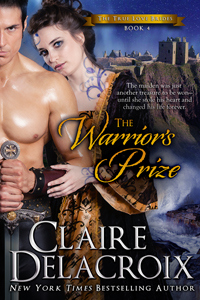
Back to my historicals, my next villain to reform his ways was Rafael in The Warrior’s Prize. In the previous book, The Frost Maiden’s Kiss, Rafael is Malcolm’s companion and fellow mercenary, a man concerned solely with his own advantage—until he sees Elizabeth, Malcolm’s sister, and loses his heart with one glimpse. She recognizes the kind of man he is, so Rafael has to change to win her hand (and convince Malcolm of his good intentions).
Rafael is prepared to win Elizabeth’s freedom from a Fae curse, regardless of the price to himself, and independent of whether Elizabeth accepts him afterward. That’s the stuff of a real hero.
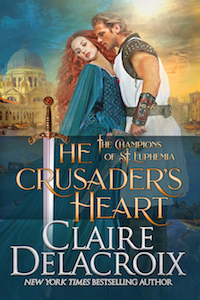
Wulfe in The Crusader’s Heart was the next hero to learn the power of love. Wulfe isn’t a villain, exactly, but he is very duty-oriented in The Crusader’s Bride and becomes impatient with Gaston for being sentimental. Wulfe’s world is very black-and-white, and he’s practical to a fault. Who better to complicate his perceptions than a widow who has disguised herself as a courtesan, a beauty in need of a warrior’s aid to escape captivity and return home? Even better, Christina is clever and she surprises Wulfe with her perceptiveness. Once these two agree to combine forces, they’re unstoppable.
I love that Wulfe abandons everything he knows to seek a future he can share with Christina, and that he’s the one to surprise her in the end.

It could be argued that three of the Blood Brothers are villains redeemed by love—a former mercenary, Maximilian is no angel when he comes to Kilderrick in The Wolf & the Witch. His half-brother and fellow mercenary, Rafael, is certainly not nobly inclined before he falls in love with Ceara in The Dragon & the Damsel. But I think the greatest villain in the series is Murdoch—until Nyssa sees his truth in The Scot & the Sorceress. Nyssa, a healer, realizes that Murdoch is driven by his grief, and that his sense of honor demands that he keep his word. She not only shows him another way to keep his pledge, but asks for his help with her own quest for vengeance—along the way, we see Murdoch’s protectiveness awakened. I really love this story of the healer and the warrior, since Nyssa and Murdoch heal each other in the end.
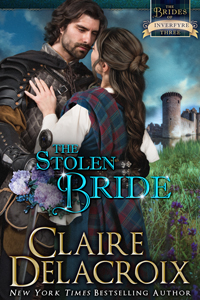
I have another villain coming due for his redemption in The Stolen Bride, publishing in December. (Writing these stories is a bit addictive, given how much I like the results!) Ramsay, the hero of this upcoming story, was the villain in The Runaway Bride, the previous book in the Brides of Inverfyre series. In that story, Evangeline, (named for her grandmother, the heroine of The Scoundrel, which brings us nicely full circle) is fascinated by the rebels in the forest who would challenge her father’s claim to Inverfyre. When Ramsay is imprisoned at Inverfyre, she boldly (and secretly) enters the dungeon to bargain with him. You can believe that he will never forget this regal beauty. The Stolen Bride begins when Evangeline leaves Inverfyre for her arranged marriage to a distant lord. Ramsay is disinclined to let her go. Evangeline has no interest in living in a forest hovel. I’m really looking forward to writing this battle of wills, and watching Ramsay change to win his deepest desire—the love of Evangeline.
There’s a little summary of my villains-turned-to-heroes, which also includes many of my favorites of my own books. Have you read them all? Do you like bad boy or troublemakers made heroes? What about villains redeemed by the power of love?




 Claire Delacroix