
Last week, I did another of my cooking experiments: I made a medieval apple tart.
I saw a post go by about the earliest recipe for apple pie coming from the fourteenth century, with this image.
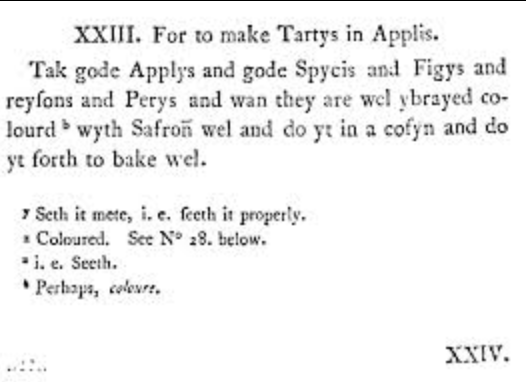
The translation from the Old English to new is roughly:
To make a tart with apples—
Take good apples, good spices, figs, raisins, pears and when they are well ground, colour with saffron, wrap in pastry and bake it well.

In some posts, this recipe is attributed to Chaucer (The Canterbury Tales) but it’s actually from a ms dated from 1381, which makes it more-or-less-contemporary with Chaucer. You can find the recipe and a modern version in Pleyn Delit (be sure to get the second edition) by Constance B. Hieatt, Brenda Hosington and Sharon Butler.
That is an Amazon.com link.
There’s another Chaucer reference there, as the title is taken from The Canterbury Tales, when the Franklin is introduced in the prologue. His defining trait is that he likes his food. 🙂
I dove down a little rabbit hole looking for the source material of this recipe. I didn’t find Chaucer at the bottom of the hole, but I did find an attribution (in PD) to a manuscript called DS. DS stands for Diversa Servicia, probably the first words of the entry. Another search revealed that DS refers to Douce MS 257 (Oxford, Bodleian Library). So, it was collected by Douce and subsequently donated to the library along with the rest of his collection.
One interesting thing about medieval manuscripts is that they can be real hodge-podges. The most extraordinary combinations of content can be be back-to-back in the same ms. That’s why libraries create indices of what’s in each one. Here’s the listing for Douce MS 257 – it’s on two pages of the index, so I have two screen shots for you:


This is from the online index for the Bodleian Library. This particular ms doesn’t appear to be scanned for a digital edition. You can see that folio 86 contains recipes, in between English rhymes, tricks and an exorcism. It’s like a junk drawer of popular culture – but at the top, you can see that the ms was created in 1381, which gives us that 14th century date. 1834 in the header is the year that the Douce collection was donated to the library, and Douce himself created a detailed index of this mss contents.
And now, the pie. Since the recipe assumes you already know how to make pastry (the coffin), I used my usual recipe. There is no sugar in the filling, so the sweetness comes from the fruit, raisins and figs. I used cooking apples (Northern Spies) and autumn pears (a variety called Sunset). Bartletts and macintosh apples would just result in sauce. I couldn’t find any fresh figs, but had some figs roasted with honey and lemon. I diced those up for the pie, leaving out the lemon rinds.
For my “good spices”, I used cinnamon and some nutmeg. I didn’t chop everything as fine as specified – the pieces were maybe 1/2″ dice – and my one cheat was adding a spoonful of minute tapioca. I baked it like an apple pie.
The house smelled wonderful while it baked! Here it is, fresh out of the oven:

It smelled so good that I cut into it while it was still warm, so the top crust collapsed on that first piece. Amazingly, it still vanished!
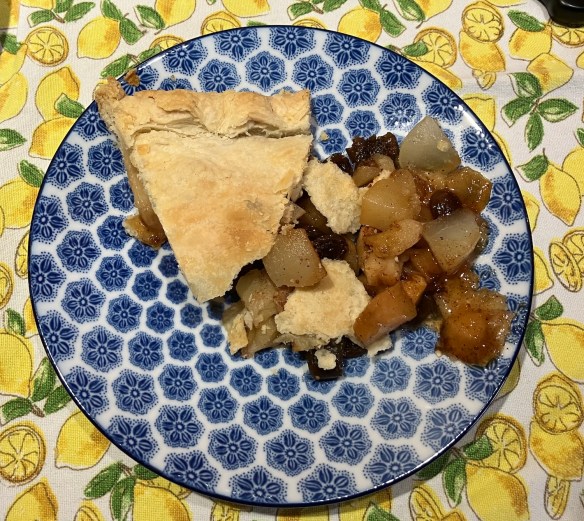
It really was delicious, and I’ll be making it again.
 Claire Delacroix